Blog

  • Cody Gakpo inspires dominant Netherlands performance

    by Ben Ayuko

    {image by Getty Images}

    Romania (no. 47 in the FIFA world team rankings), who qualified in 1st place in the group stage, would’ve thought that they were guaranteed smooth sailing in the round of 16. Netherlands (no. 7 in the FIFA world rankings), on the other hand, who qualified in 3rd place, would’ve anticipated having one of the tougher draws in this stage. So their relative emotions were definitely filled with confusion and bemusement as hey drew each other. And Netherlands were not going to look this gift horse anywhere, let alone on the mouth.

    At the start, the game was more of a tentative affair as both teams took the time to feel each other out and get a gauge on what to expect from each other. It wasn’t until the 20th minute when Cody Gakpo, who had been relatively quiet in the game until then, took everybody by surprise after receiving the ball on the left wing. He cut inside passed the defender and rifled a low hard shot to the goalkeeper’s near post. This proved to be the shot in the arm that the Netherlands team needed as they immediately responded by stepping up a gear and firmly taking control of the game. It was as if Gakpo had given them the confidence to actually show their quality on the pitch. Other players in the team who went on to have a good game include Tijjani Reijnders and Xavi Simmons. Denzel Dumfries was also a constant threat down the right wing.

    In the 2nd half, Romania seemed to realize what was happening and opted to hit Netherlands on the counter. A tactic that almost came through in the end if not for some dogged defensive intervention from the Netherlands’ defensive line. Halftime substitute Donyell Manel added some speed and trickery to the Netherlands front line and it was he who, in the 83rd minute, secured Netherlands’ progression into the quarterfinals with a relatively easy tap in from point blank range after some fine work from Cody Gakpo down the wing, that is, beating 2 defenders and the goalkeeper to put it on a plate for Malen.

    It was now a formality until the final whistle, but not before Donyell Malen scored another in his own right with the last kick of the game. Picking up the ball in his own half, he carried it down the pitch in a sort of one-man counter attack after captain Virgil van Dijk had the cleared the ball from a Romanian corner kick. He dribbled past the last defender and the wrong footed the goalkeeper with an expert finish.

    3-0 the game ended with the Netherlands headed into the quarter finals in rejuvenated fashion as Romania bowed out unceremoniously.

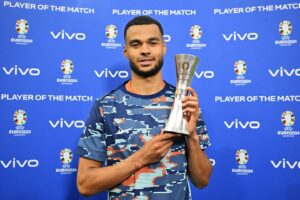
    Oh, and Gakpo deservedly won the Man of the Match Award for his contributions.

  • France Emerge Victorious over Toothless Belgium

    by Ben Ayuko

    {image by AFP}

    France and Belgium duked it out for a spot in the Euro 2024 quarter finals.

    Or at least, that’s what it was supposed to be. Truly it was a long-drawn-out affair in which neither team really possessed the quality to finish the job on the day. Chance after chance, they missed and missed. Of a total of 24 shots between the 2 sides (more from the French), only 4 were on target. And they were relatively routine saves.

    In the 2nd half, France really upped the pressure. Suffocating Belgium in their own box looking for a way in. Chance after chance fell for French forward Marcus Thuram, but he couldn’t compose himself enough to take any of them. This led to French manager Didier Deschamps, making a change, bringing in the prospect Kolo Muani. 

    He, combining with French talisman Kylian Mbappe, did their best to stabilize the Belgian defense, but couldn’t get any change. On the other end of the pitch, Belgian Centre forward, Romelu Lukaku, struggled to influence the game, in part because of the new formation Belgium adopted for this game, pushing Belgian talisman, Kevin de Bruyne deeper into midfield and further from the attacking line. They only linked up once, after a formation change pushed de Bruyne higher up the pitch. Lukaku held off the defender with his noteable strength and teed up de Bruyne from the edge of the box. His shot drew a decent save from the keeper.

    Just as it started to seem like the game was destined for extra time, and possibly penalties, the deadlock was broken. After receiving a pass from the returning N’golo Kante, substitute Kolo Muani spun around inside the box onto his right foot, looking to send a pass across goal, presumably looking for Mbappe. However, the pass deflected violently off of Belgian Centre back, Jan Vertonghen, and bounced over the helpless Belgian Goalkeeper, Koen Casteels, who had dived for the ball’s initial trajectory in anticipation.

    Belgian left winger Jérémy Doku had a good game up against French right back Jules Koundé. Their battle was the best part of the game as they constantly sized each other up and tested each other’s limits. With France having won the game, Koundé was the one chosen for the Man of the Match award.

    1-0, the game ended, with France securing their spot in the quarterfinals, and with Belgium sent packing with a feeling that they may have had more to offer.

  • Costa the Hero as Portugal Waddle into Quarterfinals

    by Ben Ayuko

    {image by AFP}

    Portugal vs Slovenia turned out to be more dramatic than anyone might have thought it would be. When the draw first happened, it seemed like it would be just another stepping onto the ultimate goal for Portugal. Nobody expected the game to be somewhat of an exhibit showcasing Ronaldo battling some inner demons.

    The first 90minutes was more of a tale of some missed chances and decent saves as Portugal struggled to find a way past Atlético Madrid goalkeeper Jan Oblak. Slovenia’s defense also looked very inspired, particularly Vanja Drkušić who was having quite a good game against the notorious Cristiano Ronaldo. With the score tied at 0-0 after 90min, we ventured into extra-time. This is where the drama really started.

    First came the penalty. Portuguese substitute Diogo Jota picked up the ball from the halfway line before carrying it all the way into the Slovenia penalty box, where he was then brought down by the aforementioned Drkušić. This would kick off a domino effect whereby previously known heroes would turn into momentary zeroes. First, it was Drkušić for giving away the penalty. Next came Ronaldo, ready to routinely tuck away the spot kick and ensure safe passage for Portugal into the quarter finals. Except, he missed. Or should I say Oblak saved it. Either way, it didn’t enter. And Ronaldo couldn’t hold back the tears as he felt the weight of his country’s disappointment on his shoulders. The 2nd zero.

    Still, we had 15min to go in extra time, and anything could happen.

    And it very nearly did. A mistake from Portuguese veteran, Pepe, the 3rd zero, let Benjamin Šeško run through on goal, one on one with Diogo Costa, the Portuguese goalkeeper. Sesko, the young jewel of Slovenian football, would add himself to the list as the 4th zero, as he missed the opportunity to secure qualification for his country. Or should I say the keeper saved it. Either way, it should’ve been a goal, but it wasn’t. Extra time was now up. It was time for the dreaded penalty shoot-out.

    Now, this is where everything changed. Because, as close as the game actually was, the gulf in quality between the 2 sides shone brightly here. Up stepped the Slovenian heroes, Josip IličićJure Balkovec and Benjamin Verbič vs Diogo Costa. 3 penalties they took and 3 times they missed, Costa saving each penalty with relative ease. 3 more zeroes.

    On the other side, Ronaldo stepped up first, seeking redemption, which he got after slotting the kick passed Oblak and then turning to the crowd and begging for forgiveness for his earlier miss quite earnestly. Next was Bruno Fernandes, who made a mockery of the tense affair, then Bernardo Silva sealed it with an expertly taken shot.

    Portugal safely through, Slovenia sent packing, but not before giving us one of the more memorable cup ties of the competition.

  • Who was on the Wrong?

    by Ben Ayuko

    {image by TSN}

    Before we get into it, I just want to say, it was a thoroughly entertaining battle. Both drivers wanted to win, and they drove each other to the limit in order to earn the victory. Unfortunately for them, they both lost out on the victory. Fortunately for us, we may have just witnessed the beginning of a rivalry.

    Christian Horner, Red Bull’s team principle, was quoted as saying “Lando Norris kept divebombing Max…. He was a little too over eager” A sentiment shared by Max Verstappen. Lando Norris was quoted as saying, “He knew what he was doing. He was on the Wrong.” Which brings us to the topic at hand. Who actually was on the wrong?

    Max Verstappen is obviously notorious for his aggressive, uncompromising, elbows-out style of driving that often leads to incidences on the track. That is to say, this isn’t the first time we have seen him get into such an altercation in a race, the Brazilian Grand Prix in 2021 being a very good example of this. However, did he actually break any rules? Are Formula 1 drivers allowed to be so aggressive in defense of their track position?

    The rules of attack/defense on the track are as follows. When defending, you, as a driver, are not allowed to move more than once. Which means, you have to predict which direction you think the driver behind you is going to go, and then time your move strategically and commit to it. Once committed, you cannot then move to the other side. Another rule states that you are not allowed to force another driver off the track, whether in attack or defense. Lastly, you are not allowed to leave the track in order to gain an advantage, whether attacking or defending.

    Now, these 2 drivers battled for the lead of the race for nigh on 7 laps. And in every lap, these rules were being pushed further and further. Too Norris’ credit, he chose to be quite the gentleman and gave Verstappen fair room to manoeuvre around and even let him take the lead back ahead after he masterminded an overtake from off the track. Verstappen, however, as we all know by now, does not take any prisoners and he ensured that Norris would have to almost physically take the position from him if he wanted to take the lead. He would genuinely risk crashing out of the race rather than surrender the position. Some would say it is dirty driving. Others would argue it is only the mark of a winner who cannot stand to lose, a la Michael Schumacher and Ayton Senna.

    One argument gaining a lot of traction states that it has been too long since Verstappen actually had to fight anybody on the track and the sudden pressure put on him by Lando Norris was a lot for him to cope with on the day. And as much as he seemed to have evolved into a more levelheaded and tactical driver, this showed that he was still the same old bullish Max Verstappen.

    There is also an argument to be had that Lando Norris was a little too naive when attempting to overtake him. Verstappen may have been overly aggressive, but Norris should have known better than to simply expect him to willingly give up the position, as has been the case in earlier incidents when the roles were reversed.

    At the end of the day, all we can say is, more of the same please. Red Bull and Verstappen have had a strangle hold on the game for far too long now. It is refreshing to see things shaken up a bit.

  • Russell Takes Advantage to Win Austrian Grand Prix

    by Ben Ayuko

    {image by BBC}

    There was drama on the track at the Austrian Grand Prix on the 30th of June 2024 as the fight for the race win resulted in both drivers losing out.

    For about 50 to 55 laps of the Austrian Grand Prix, it was relatively business as usual. Max Verstappen had opened up a lead in his Red Bull, Lando Norris was trying to keep up with him in his Mclaren and George Russell was sneakily going about his business in the last podium position in his Mercedes. Apart from some fireworks between teammates Sebastian Ocon and Pierre Gasly of Alpine as they engaged in their usual wheel to wheel duel, there was little else to write that is. That is until the teams made their second pit stop of the day.

    After complaining about tyre performance, Max Verstappen made a pit stop to swap out his hard tyres for the mediums. Lando Norris had the same idea. Norris’ pit stop went smoothly. Verstappen’s did not. Some extra time taken to fit the left rear tyre meant that by the time they got out of the pit lane, Verstappen’s 7sec lead had been cut down to just 2.5sec.

    Norris then began applying the pressure. Lap after lap, constantly hounding Verstappen, looking for a way past him. More than once, he attempted a brave dive bomb into the corner, but Verstappen’s cheeky antics made it impossible for Norris to position his car for a proper overtake. The tension was building with every passing lap, until finally…they made contact. Norris attempted an overtake around the outside on a hairpin corner and because Verstappen edged slightly to his left to try and put him off, they came together in the most dramatic fashion. Both cars suffered a puncture and had to limp back to the pit lane, with Norris suffering front wing damage as well, resulting in him retiring the car.

    George Russell, who was quietly going about his business in 3rd, suddenly took the lead of the race with about 5 5 laps to go. He couldn’t believe his luck as he took the chequered flag to claim his 2nd ever Grand Prix win.

    Norris’ teammate, Oscar Piastri pipped Carlos Sainz for 2nd as the latter rounded up the podium positions.

  • Redemption for India as South Africa fall just short

    by Ben Ayuko

    {image by Reuters}

    India was crowned world champions after beating South Africa in the ICC (International Cricket Council) Twenty20 world cup final.

    India was looking to reclaim some pride after losing the ODI series to Australia in front of their home crowd earlier this year. The Indian team came up against an inspired South African side who had just come from demolishing Afghanistan in the semi-final, limiting them to just 56 runs in total. The game was always going to be won by whoever wanted and the India side definitely showed its intent by beating England, the defending champions, in the semi-final by a mammoth 68 runs. This was promising to be an epic clash.

    And it was. It was a tense finale as South Africa found themselves needing at least 2 boundaries from 2 balls. Kagiso Rabada, the batsman, had no choice but to throw caution to the wind. Go big or go home, as they say. Unfortunately, he didn’t go big enough as his attempt to knock one over the line fell just short, right into the hands of an Indian fielder. India emerged victorious but only by a mere 7 runs. They definitely earned their victory after battling a worthy adversary.

    Virat Kohli was voted the MvP (most valuable player) finishing the game with 76 runs from 58 balls.

    Jasprit Bumrah capped the final game by winning the Player of the Tournament award, no doubt because of his proficiency at bowling.

    The fans may have been disappointed by how the ODI series ended, but at least they were afforded some sort of redemption for the mishap in the Twenty20.

  • Honoring the Legacy of Mutegi Njau: A Pillar of Kenyan Journalism

    By Joe Aura, aurajoe6@gmail.com

    In a career that began in 1979 and spanned decades, Mutegi Njau emerged as one of Kenya’s most respected and influential journalists. Known for his keen attention to detail and mastery of the trade, Mutegi’s journey in media blossomed during the era of Kenya’s founding president, Mzee Jomo Kenyatta, and continued to shine brightly through the subsequent decades of President Moi’s regime and beyond. His insightful contributions to the media, particularly through his popular morning show “Cheche” on Royal Media Services, left an indelible mark on the industry. (https://youtu.be/a3yAzxsXtqE?si=WdBAah8x4dGxKaP4)

    Former co-host David Makali shared his sentiments on social media, saying, “Devastated by the passing on of senior colleague, co-host, and panelist Mutegi Njau. May your toil on this earth be rewarded and your memory last forever among those you mentored and gifted, or who savoured your goodness.”

    Key Contributions and Impact

    Mutegi was more than just a journalist; he was a mentor to many, shaping the careers of countless journalists who followed in his footsteps. His family fondly described him as the cornerstone of their home and a cherished figure within the community. His presence as a resident analyst on Citizen TV’s ‘Cheche’ power breakfast show made him a household name, where his commentary was both respected and anticipated. His career was marked by several significant contributions:

    1. Mentorship and Training: Mutegi’s mentorship influenced many journalists, helping to shape Kenya’s media landscape. His rigorous training and guidance left a lasting legacy on the standards of journalism in Kenya. Head of Deputy Presidential Communication Service Njeri Rugene, in mourning his loss, reflected on his profound impact: “Mutegi Njau made an indelible mark in Kenya’s journalism. He trained many of us. He has left a rich legacy. It is time to rest. Rest in Peace Senior.”
    2. Insightful Reporting: As highlighted in the video featuring his discussion on World Press Freedom Day , Mutegi consistently advocated for press freedom and ethical journalism. (https://youtu.be/Nw7285XT-4c?si=VCdZauSUN3N2ZQbj – World Press Freedom Day With Journalist Mutegi Njau)
    3. Memorable Interviews and Coverage: His recount of memorable moments with President Moi showcased his deep understanding and nuanced reporting of Kenyan politics and history. This ability to capture the essence of significant political figures and events was unparalleled. (https://youtu.be/_O4XYP0Pud4?si=r9cmGsAH1Ym6HDSu – J.K Live Citizen, Veteran Journalist Recount Memorable moments with Moi (part 1) with the great story teller Yususf Wachira, Force to be reckoned with – Lee Njiru and Mutegi Njau a great Journalist.)
    4. Tackling Tough Issues: In various discussions, including those on media and hate speech , Mutegi did not shy away from challenging topics, emphasizing the role of media in fostering national unity and accountability.

    (https://www.youtube.com/live/gE9nY8iSipg?si=igZCo-uYvQo93x8A – The Agenda with Mutegi Njau

    https://youtu.be/zJm4Rz-VWSw?si=Tf_zhjyZ7TfY8U1x – The Judiciary Open Wounds

    https://youtu.be/bkfFVJMKB5w?si=j9zy0Kj8tEmHtqQ0 – He speaks om media and hate speech on Media Focus On Africa.)

    A Tribute to His Legacy

    As Kenya witnesses a rise in protests and journalists facing increased risks on the field, Mutegi’s legacy becomes even more poignant. His commitment to truth and ethical reporting provides a guiding light for today’s journalists. The recent mishandling of journalists during protests underscores the importance of Mutegi’s principles—diligence, integrity, and bravery in reporting.

    Current journalists and students of journalism can draw vital lessons from Mutegi’s career, especially in the wake of covering protests. His ability to maintain composure, seek truth, and report with accuracy amidst turmoil is a testament to his professional prowess. Upcoming journalists can learn the importance of mentorship, ethical standards, and the crucial role of media in democratic societies.

    Rest in peace, Mutegi Njau. Your legacy lives on in the hearts and minds of those you touched and in the fabric of Kenyan journalism.

  • EVALUATING THE BUDGET ALLOCATIONS FOR THE FIRST LADY AND DEPUTY PRESIDENT’S WIFE.

    By: Vivian Bundi

    The budget allocations for the offices of the President’s wife and the Deputy President’s wife have always been a point of interest and debate. The recent increases and decreases in these budgets reflect shifting priorities and economic realities. In my opinion, the significant budget allocated to these offices is not justified, especially compared to the previous years. This stance is based on the need for fiscal responsibility, prioritization of essential services, and the importance of maintaining transparency in government spending.

    The recent budget allocation for First Lady Rachel Ruto’s office has increased the original amount by 17.3 out of every 100 units, reaching Sh696.6 million (openbudget.or.ke)  for the new financial year starting July. This is a notable rise from the Sh593.9 million allocated in the current financial year. A substantial portion of this increase is directed towards the payment of salaries. While it is important to support the initiatives undertaken by the First Lady, such as environmental and climate action, financial inclusion, and women empowerment, the significant increase raises concerns about fiscal responsibility. The government must ensure that such budget increases are justified by tangible outcomes and not merely by expanding administrative costs.

    By: T-One Tv Kenya

    In contrast, the budget for the spouse of Deputy President Rigathi Gachagua has decreased from Sh717.6 million to Sh557.5 million ( https://openbudget.or.ke/search/First+Lady//). This reduction follows a substantial increase through a mini-budget tabled in the National Assembly in October of the previous year. Despite this reduction, the combined budget for the First Lady and the Deputy President’s wife will total Sh1.2 billion in the new fiscal year, slightly down from Sh1.3 billion this year. This allocation needs to be scrutinized in light of other pressing national priorities such as healthcare, education, and infrastructure development. The government should consider whether these funds could be better utilized in areas that have a more direct impact on the well-being of the general population.

    Comparing these allocations with the budgets during the Kenyatta administration provides further insights. In the year starting 2013, the combined budget for the offices of the First Lady and the Deputy President’s wife was Sh187.3 million. By the end of the Kenyatta administration, this budget had grown to Sh723.6 million, reflecting an increase of 286 percent. Specifically, the budget for Mrs. Kenyatta’s office increased from Sh114.4 million to Sh426.1 million, while that of the Deputy President’s spouse increased from Sh72.9 million to Sh297 million.

    This dramatic rise in budget allocations was primarily directed towards recurrent expenditures such as salaries, travel expenses, and hospitality. Despite calls for cuts in non-essential spending during the Kenyatta administration, the budgets for these offices continued to grow. This trend raises questions about the prioritization of spending and the necessity of such substantial allocations for non-essential functions.

    The need for transparency in government spending is paramount. The increased allocation to the First Lady’s office under Rachel Ruto and the significant budget for the Deputy President’s wife must be justified with clear, measurable outcomes. Mrs. Ruto’s initiatives, including the Women Economic Empowerment (WEE) program aiming to mentor and train 90,000 women in financial inclusion by July 2025, are commendable. Similarly, Mrs. Rigathi’s focus on empowering the boy child and her targets of identifying and screening 12,000 boys for drugs and substance abuse are important. However, the effectiveness and efficiency of these programs must be transparently evaluated to justify the substantial budgets allocated.

    The current economic context cannot be ignored when discussing these budget allocations. Government revenue shortfalls and reduced economic activity necessitate careful consideration of all expenditures. In the first nine months of the current financial year, government revenue fell short by Sh97.7 billion, forcing the Treasury to cut budgeted funds for development projects by nearly Sh34.37 billion. Given this economic backdrop, it is imperative to question whether the significant budgets allocated to the offices of the First Lady and the Deputy President’s wife are the best use of limited resources.

    In conclusion, while the offices of the First Lady and the Deputy President’s wife undertake important initiatives, the substantial budget allocations they receive need rigorous scrutiny. The comparison with previous years highlights a trend of increasing budgets that may not be fully justified by the outcomes. In a time of economic challenges, fiscal responsibility, prioritization of essential services, and transparency in spending are more important than ever. The government must ensure that every shilling spent contributes to the greater good of the nation, rather than expanding administrative budgets without clear, tangible benefits.

    viviankbundi@gmail.com

  • The Falcons

    by Ben Ayuko

    {image by Daystar University Logo}

    “The Falcons”

    This is Daystar University’s team name. As in, the official name of the Daystar Sports teams. Any Sports team. Every Sports Team. And there are about 15 different ones. Let’s talk about that a little.

    Sports have always been an area of pride in Daystar University with many resources being allocated toward developing the sports sector.

    There is a management team that is in charge of running the sports department. This consists of

     Th General Manager- Maurice Masiga

    The Assistant to the Manager- Rachel Njoki Mwaura

    The Head of Activities- John Yidah

    The Head of Statistics- Barrack Khaseke

    The Athi River Campus Sports Secretary- Safari Peter

    The Nairobi Campus Sports Secretary- Daisy Kamau

    These are the people responsible for allocating and maintaining the resources afforded to the sports department.

    So, what are these Resources? Well, there are a variety of Arenas for the games that require them (Football, Rugby, Handball, Volleyball, Basketball, Tennis, etc.), a Gymnasium fully stocked with equipment, Falcons Kits/Jerseys to be worn whenever the school teams are participating in national competition, Transport for the sports teams to travel to and from Nairobi just so all the members can train together, and on game days where they have to travel. Their meals are also catered for by the school on the day.

    That being said, just what are the Sports represented by the Falcons?

    Well, we’ve already heard Football, Rugby (both 7s and 15s), Basketball, Volleyball, Handball and Hockey from the examples above. All of these have both their male and female teams {at the time of writing, Female Rugby is in the works}. Other sports include Lacrosse and Netball. All of these sports are done in the presence of the natural elements or “Outdoors” as they are referred. For the “Indoors” sports, there’s Darts, Athletics, Badminton, Chess, Scrabble, Lawn Tennis, Karate and Swimming. New sports are always being considered for this list. Currently, the word on the street is that Boxing will become the latest addition.   (If you’re reading this in the not-too-distant future, did it happen?)

    Some of these teams are big enough to be registered under KUSA (Kenya University Sports Association); the governing body that oversees sporting in universities in Kenya. This gives them access to the KUSA Leagues but still enables them to participate in the National Federation Leagues. For instance, The Football Falcons play in the University tier under FKF (Football Kenya Federation), Rugby plays under KRU (Kenya Rugby Union), Basketball plays under NBA Kenya (National Basketball Association in Kenya), Hockey under KHU (Kenya Hockey Union) and Handball under KHF (Kenya Handball Federation). These leagues are usually active from late June/early July playing various friendlies in preparation for the season which begins in September and runs up to February/March. The school team training usually happens on Tuesdays, Wednesdays and Thursdays from 5: 00p.m to 7: 00pm. The tournament games are played on Saturdays and sometimes Sundays.

    This year (2024), the Falcons will also be participating in the East African Championship Games starting in December, having qualified for the competition. This is the competition whereby different teams from different Universities from different countries (in East Africa) get the chance to meet and test their mettle against each other. The following teams from Daystar qualified for the East Africa Games:

    Beach Volleyball Falcons 

    Handball (Ladies) Falcons

    Karate Falcons

    Scrabble

    The school also occasionally hosts sporting events. This includes the Floodys – a popular Basketball tournament, The DSL (Daystar Soccer League), Swimming Gala, among others. The “Beyond the Try” initiative is an annual Touch Rugby tournament orchestrated by the men’s Rugby Team Coach Caleb Bosire and his colleagues. Its aim is to promote school rugby and generate money to grant scholarships for talented youths.  There is the “Sports Awareness Week“, a week which is dedicated toward exploring the pros and cons of sport and weigh them against each other, (and also recruitment of new team Falcons).

    Now, the objective of any sporting activity is to determine the winner. Or at the very least, to show off one’s skill and proficiency in said sport. The Falcons of Character Awards (FOCA) Dinner, which is a dinner held exclusively for members of the sports teams, is hosted by the school and it is a way for the Falcons community as a whole to celebrate one another and crown whatever achievements were made in the year.

    If you’re reading this article and you’re thinking about applying to become an honorary Falcon, you should. You don’t even have to know anything about the sport you want to try. The teams are more than happy for you to learn as you go. There are many examples of students who have gone into rugby/tennis/volleyball etc. without even knowing the rules of the game and later emerged as integral members of the squad. So go ahead and contact the Campus Secretary (Athi – petersafari211959@daystar.ac.ke, Nairobi- daisykamau223621@daystar.ac.ke) or the Sports department- Falcons@daystar.ac.ke in order to apply. They are always ready to assist you.

    Falcons Take Matters into their own Hands.


    Oh, I almost forgot, there’s also a ping-pong table in the dining hall and it gets very competitive. Almost as competitive as it gets at the pool table right outside the gym. I mean, these aren’t officially school sports, but you wouldn’t know it if you played a game.
  • Romania Tops Group as Belgium scrapes Through

    by Ben Ayuko

    {contact info: gnrlspecific@gmail.com}

    {image by Getty Images}


    What in the world is going on in Group E?

    It genuinely feels as though each member of the group had a pact agreed at the launch of the tournament, but one of them found out too late that they were going to be the sacrifice. I know it sounds like I’m being pretty dramatic but hear me out.

    Romania qualified for the next round after finishing top of the group after their 1-1 draw with Slovakia, thanks to goals from Ondrej Duda of Slovakia and Răzvan Marin of Romania. Slovakia qualified in 3rd position. Had Slovakia won that game, it would have been they who finished top of the group and Romania would have been packing their bags and going home. Likewise, if Romania won, then Slovakia would’ve been packing their bags. Such fine margins.

    Belgium tried to get up to speed versus Ukraine in order to finish top of the table, but the longer the game went on, the more they slowly began to accept that they would probably not get that elusive goal that they were looking for. In fact, it was looking more and more likely that Ukraine would score. Their closest effort came directly from a corner kick after Ruslan Malinovskyi almost caught the Belgian keeper Koen Casteels off guard at his near post. That scare seemed like the off switch for Belgium as from then on, they opted not to take unnecessary risks knowing a draw would get them through anyway.

    0-0 after the final whistle meant that Belgium qualified in 2nd while Ukraine drew the short straw and had to pack their bags. If either team had got a goal, they’d have finished top of the group while the other was sent packing. Such fine margins.

    Every team in Group E finished the group stages on 4 points. Every team had 1 win, 1 draw and 1 loss. The rank in the group was determined exclusively by goal difference from top to bottom, and in some cases where the goal difference was the same, they had to compare the number of goals scored. It’s madness.