Category: News

  • ‘HUSTLER’ CSs WORTH SH 6BN

    {Photo courtesy of Victor Matara}

    By Nicole Waweru

    (Email: wanjirunicole28@gmail.com)

    On Monday 17, October, the selection parliamentary committee began vetting President William Ruto’s Cabinet nominees. The nominees are; Musalia Mudavadi, the former Amani National Congress (ANC) leader with a net worth of ksh.4 billion, Justin Muturi, former speaker of the National Assembly of Kenya with a net worth of ksh.700million, Aden Duale, Garissa Township Member of Parliament (MP) with a net worth of ksh.851 million, Alfred Mutua, the former Governor of Machakos County with a net worth of kshs.420 million, and Alice Wahome, the MP of Kandara in Murang’a County with ksh.218 million.

    Shock hit Kenyans after the immeasurable wealth of these nominees was revealed in Parliament, this sparked a conversation on Twitter as many Kenyans said that the politics in Kenya is very remunerative. In as much as some had worn the lens of ‘politics being lucrative,’ others had however accredited their wealth to corruption, which is still not a surprise. Some were questioned about their past encounters with corruption scandals like Mudavadi, who was asked about the Goldenberg and Nairobi Cemetery land scams. For the Goldenberg scandal, he told the committee that he inherited the scam at the Treasury at its tail end and some of the transactions were unknown to him whereas, for the Nairobi Cemetery land scam, he said he faced a politically instigated investigation by the then Kenya Anti-Corruption Commission, (KACC) and in the end, the culprits were caught and jailed.

    Looking at the wealth attained by these Cabinet nominees, we can see that their wealth is also constituted by separate and individual ventures that they carry out outside of politics. For example, one of the nominees, Justin Muturi, says that his income comes from the pension he is earning after serving as a speaker of the National Assembly for ten years, from farming and legal consultancy. He also added that his property was acquired through bank loans and a civil servant stipend for the last 36 years of his career.

    The vetting and nomination process in Kenya is seen to be very orderly, the 12th Parliament amended the Public Approval and Parliamentary Approval Act 2011, to increase the vetting period from 14 days to 28 days. According to research from Mutai, (2022), once the Committee on Appointments receives the list of the Cabinet nominees, the clerk will be required to issue a public notice asking Kenyans with representations to submit memoranda on the nominees. With the nomination process in Kenya, once the Parliament completes the vetting which is set to end by Saturday 2:30 pm, the clerk will notify the President of the decision made within seven days of the decision. Article 152 (1) of the Constitution says the Cabinet includes the President, the Deputy President, and the Attorney-General, and not fewer than 14 and not more than 22 Cabinet Secretaries.So, the question that has been the talk on all social media handles is, “Is politics profitable?” My answer to this is yes. It is no doubt that the Members of Parliament (MPs) in Kenya are amongst the highest paid in the world relative to the size of the economy. Parliament seats are one of the most coveted positions in Kenya this is supported by the holder’s wealth and social ranking. In the years before, there has been an evident trend of those in high senior private sectors leaving, in quest of more laid-back political offices.

    As the ongoing vetting goes on, we hope that these nominees are very passionate about what they are fighting for right now, and when they are appointed, they will stick to their word and do fulfill all the promises that they have made. Their words are on record and I am sure many Kenyans will want to see them be true to their word.


  • MWYNE UNFILTERED

    By: Gertrude Prosper

    getrude2003@gmail.com

    The Daystar University Students Association (DUSA) Secretary General Desmond Mwyne was summoned to appear at a hearing before the Congress on 18 October 2022 in Athi River, main campus.

    The purpose was to address an offensive comment he posted on his social media, insulting D.U students. He was summoned by the council on multiple accounts of insulting students and solicitation of funds. In attendance were twenty-six members of Congress from both the main and Nairobi campus.

    At the hearing chaired by the Speaker of the house, Evans Owino, Mwyne sat composed facing all members present. He was to explain in detail the use of the seven hundred thousand given to him by the finance manager to cater for the event.

    “The money was spent on shirts, grounds, quality sound, a stage, food and buses and there were still some risk factors because we cannot scan loyalty”, he said. Without having brought receipts as proof, the council found his statement incomprehensive.

    The Speaker then inquired who allowed the students to be charged sh.200 as an attendance fee and the S.G had the following to say. “I told the finance manager in front of my committee, by virtue that I don’t have the 900k I asked for the event, therefore for the 700k I will have to charge students, which she approved. We charged every student 200 each to meet certain expenses but still at the end of the event we had a debt of 55k.”

    “We didn’t lock people out but the money we were allocated determined how many people would come,” Mwyne responded.

    A dissatisfied student, Catherine, was in attendance as a witness. “I wasn’t very sure whether we were supposed to pay for the event, but after confirming with the SG I paid. Surprisingly, we were left by the bus and didn’t attend the event. I was shocked to hear the SG on the phone using vulgar language on us, saying “leave those people I don’t want unnecessary chaos” and yet he is the one who told us to pay”, she said.

    The Speaker proceeded to read a screenshot of a conversation between a student inquiring about the event and Mwyne’s blatant rude response.

    Forming beads of sweat on his nose and his hands unwillingly trembling, Mwyne accepted the impudent response to the inquisitive student but denied posting the above-quoted statement.

    “We are living at a very crucial time where things are shared on the internet, and in the current era of so much information, therefore anyone can do that. I am a public figure and anyone can access my photos, therefore I never took those photos nor posted them though I saw them circulating”

    The council is yet to decide on his fate.

  • ‘Go to Uni’ they said

    By Nicole Waweru

    wanjirunicole28@gmail.com

    Life after high school sure did look like it would be the best thing that would happen to us, didn’t it? I am sure many of us were just eager and excited to start campus life, a life without restrictions and one where we are free to do whatever we want, whenever we want. As much as campus life is a dream it has still proven to have both its challenges and fun side.

    According to a survey I did recently, many university students do in fact struggle in university, and one that mostly popped up was that getting to an early 8 am class has become a struggle, especially for those staying off-campus. There are issues of traffic, having lecturers who cancel classes after you have woken up very early to go to school if you struggle with social anxiety, then making friends becomes a huge problem and not hearing your alarm hence, waking up late.

    “Since I commute to school, I often lack time for revising because I am always waking up early and getting home late from school,” explains a student from Kiambu Institute of Science and Technology.  

    However, university is not all that bad. Your university experience can be really exciting depending on what you do in campus. Joining different school clubs and associations can help build your interpersonal skills and can help you break out of your bubble and interact with different people. Comparing University to high school you can clearly see the differences that are present. For example: in campus you have the liberty to plan your schedule when choosing your classes, you get to socialize with a lot of different people.

    “I get to have fun and a lot of freedom to do what I want, in return I learn a lot of life lessons as well,” a student from Maseno University explains.

    Also, balancing your social life with your school work is also very important. University is also school and as much as you are enjoying your freedom you need to also prioritize your studies and work hard at school; we all need to graduate at the end of it all. If you know that you are a morning person, then you can plan and wake up early and study and vice versa. Do not forget and party every weekend of your semester, at least do it every other day, revise your school work and catch up on group and personal assignments.

    “As much as I am introverted, I try to create time for friends and family by making sure I am done with school work earlier,” a student from Daystar University says.

    “I set time very early in the morning to study and do all my assignments and take away CATS if any,” a student from Kenyatta University explains.

    Lastly, remember that in university all it takes is your self-discipline and your own personal goals. No one will follow you around in campus but remember that it is your life and you literally have power over your future. All you need to do is remember to study and interact with people. You learn new things along the way, you get into relationships both platonic and romantic relationships. Like I always say, just remember who you are and be YOU.

  • MEDIA GURU & AFP’s CELINE CLERY ON NEWS COVERAGE, REPORTING AND WRITING FROM THE HUMAN PERSPECTIVE.

    (Photo courtesy of Wangui)

    By Hannington kinuthia

    An exuberant session took place at Daystar University in DAC 606 that brightened up an early gloomy Wednesday 27th July 2022.

    Under the guidance Ms. Wairimu Gitau, the facilitator for the day, the freezing audience was warmed by the presence of the guest speaker, Celine Clery, an expert in news coverage for more than a decade. A rejuvenated audience of distinguished learners had their pens ready to take notes of the day’s lessons on video production in news coverage.

    The French oracle of news coverage, Mrs. Celine Clery, took center stage to familiarize all and sundry with the gospel. Her journey kicked off a decade ago when she was invited to work with Agence France-Presse (AFP) shortly before relocating to the Europe-Africa desk in London. Seven years and still counting, she has been AFP’s video coordinator for the East Africa region based in Nairobi.

    Astonishingly, she supervises news coverage from 14 countries, and just not to be mistaken, her prolific nature has led to her reporting in nearly all of the region’s states! A distinguished student in the class of media reporting, she has numerous mind-blowing achievements, Celine has superbly engaged presidents and was a frontline reporter in Sierra Leone for the Ebola calamity and the migrant crisis in the Mediterranean. She is a living icon in the field of journalism- news coverage.

    AFP is a French news agency that moves outside the country’s boundaries to propel happenings around the globe, inherent in 151 countries. Consisting of over 1000+ journalists , the news agency covers stories, packages them, and markets them to respective media houses even here in Kenya.

    The main aim of AFP is video coverage from a human perspective. With a monopoly of unique ideas on the technicality of video coverage that is termed as Golden rules of AFP-Shooting, Editing, and Dope sheets, three key factors in a video coverage. These skills and techniques took learners’ breaths away undoubtedly.

    In video shooting, friends of the lens (photography enthusiasts) got a new dawn of grace after being updated with excellence in taking shots. In shooting, context is key -images must tell, where we are, and what we are talking about. Interviews observe the rule of the thirds (not centered) upon only one interviewee, it is most advised to switch locations. Under editing, the best images come first on the timeline with image lengths of between 30 sec to 1 min.
    The order of soundbites is a mirror image of why you are covering the story. Dope sheets. Here she keenly described how headlines describe the video, Leads must describe the content of the video as well as give relevant context.

    A projected slideshow performance by Celine was an enlightener and the game changer to the dumbstruck and tongue-twisted learners who had their eyes glued to the projector screen in utter loathing to their thoughts that provided false beliefs to each self that they were ripe with content. A keen gaze into AFP (Agence France-Presse) notes threw off a keen but taciturn audience with how the agency gathers news from France and around the world with factors such as being timely, objectivity, factual, and credibility meticulously considered.
    Celine insisted on the journalistic tasks in the newsroom and on the field while reporting. Professionalism is non-negotiable! In the event of interviewing high-profile individuals in society- Heads of states and government, Ambassadors, delegates- it is unprofessional to take selfie pictures with them (not unless requested by the interviewee to have an official photo) and post them on your social media accounts with catchy captions, blowing up the social spaces.

    According to her, she argued, that when in the field covering a story in whichever part of the world, as a reporter, it is expected of them to stop existing in their social media lives, remaining inanimate is of great relevance for the production of a masterpiece of a story without eliciting premonition to the audiences.

    Ethics and codes of conduct for journalists! Knowing what to do is just as important as knowing what not to do. Biasness in the field could lead to disastrous outcomes, assassinations not an exception. She insisted on involving both sides of the party to avoid being one-sided in reporting or writing. Understanding the impact a story can bring -cold war and tensions- should educate oneself on whether to let the story go on air or to kill the story to serve a greater interest. There was plenty covered under codes of conduct -filming children, sexual victims, obscuring pictures and names, accountability, independence, acts of violence, and election reporting.

    Based on the approaching august polls, Celine argued out on the techniques of covering an election story. In France, on the day of voting, one is restricted to participate to cover a story on who a citizen is voting for. Increasingly unlike here in Kenya, we have witnessed reporters on field duty giving airtime to citizens to pronounce their preferred candidate, a challenge posed to the media.

    In Celine’s words, development and pre-production make up 50% of your story. Consideration of the 5Ws+H rule is not an option in coverage. Drawing to the session’s commencement, a feature story from in attendance Celine Nyangere, a master’s student, done and posted on YouTube courtesy of Look Up Tv, with the title Young Hustle: A young spoken word artist, was projected, similarly, the class facilitator, Ms. Wairimu Gitau’s feature story with the title Idle no more, was also reviewed. Both feature stories are a serious bone of contention to attendees.

    Ultimately, the closing remarks from Celine emphasized the ability of journalists to be backpack-type of journalists. Being able to be multi-skilled is an upper hand when being in the field or searching for a job. Fact-checking, just as one of the AFP objectives, should be an inherent value in media personnel, engaging with authorities also before filming a story and cross-checking your work before final submission. Notable smiles beamed the room upon departure.


  • THE “HEAVY” BUS.

    BY HANNINGTON KINUTHIA

    kinuthiahannington@gmail.com

    A brutal knockout blow is finding its path to the faces of unwitting students within the institution through a possible increase in bus fares on school buses. With pace, the vicissitude is increasingly rearing its head into the school and making itself comfortable at the painful cost of the students. However, it can be argued from different angles what really might be the thought behind such a grisly conclusion.

    At the national level, the hungry and unforgiving covid monster has left no one free from its vicious teeth. The monster has increasingly caused more harm than good in the nation -perhaps the unaffected, but in a very “unique” way could be those who were found guilty in the embezzlement of the covid-19 donated funds, danced their way to the banks with briefcases suffocated with unclean cash, amid a vulnerable nation where darkness was the candle. The pandemic has left many jobless across the country and others having their salaries slashed by more than half!

    Daystar University Bus at the Athi River campus gate

    President Uhuru Kenyatta in his speech during Labor Day celebrations this year acknowledged that more than half a million Kenyans would lose their jobs during these dark times due to the pandemic invasion in the country. He stated the measures that his government and the public servants across the three branches of government have taken in trying to neutralize the situation by taking a salary pay cut. Sentiments that have remained to be utter dark speak, same archaic narratives, that have been narrated for years; that have now made the hapless youth take a temporary step back in engaging in this upcoming election.

    The cost of living has rapidly and incessantly been going up daily as if it is being worked on resolutely to continue blowing up, from the cost of fuel which propels a bizarre conversation to the cost of food, surprisingly sh10 is slowly building on the route of losing value -sh5 is dead and buried! In a successive random conversation with one of the daystar bus drivers, driver Mulwa reiterated that the cost of living has challenged the normal operations in the transport industry. He recalled numerous incidents he had to refuel while on a journey he anticipated was going to be a success without a revisit to the gas station. The distance covered by the bus is gradually moving out from the bounds of an Sh150 sphere. Which assures all consumers of the service that the sad reality may soon be effective.

    Currently, the school bus fare is at a sad sh150 and the consumer is struggling to locate space to breathe, upon the addition of a cent on the current sh150, it could be the last breath. An utter assassination of the ordinary folk. In a random census I conducted among students from the Main Campus who were taking their errands from the Nairobi campus, out of every 10 students, 7 relayed their disappointments and threw the kitchen sink to the DUSA government, the transport sector, and those in the upper echelon of not being considered when drafting policies, citing that the current sh150 is a burden preceded with hurled unprintable

    The transport department may swiftly and hurriedly run away from the ruthless reaction upon the implementation of the idea from the students, and turn it to the general increased cost of living. In full realization, it is quite unthinkable to tighten up the nuts without a clear account of the reasons, and even with reasons, it can still be senseless to add fuel to the current fire, it makes one begin even doubting whether the interests of folks do ever cross their minds at any given time. Unlike the proverbial ostrich that burry its head into the ground, the school’s upper echelon and notable respective are regarded with dignity and of sound mind to jet in and salvage many from such a scenario -an increase of fare.

    The Art of Seduction.

    Lastly, as part and parcel of the distinguished liberal arts institution, which I veritably take pride to be a member, sometimes the struggle to understand the coordination and running of usual activities in school, continues to fatten my mind. Vehemently, I pose to disagree with any sort of increment on the school’s bus cost, the bus is getting heavier daily. The art of seduction, a book by Robert Greene perhaps in the most minimal chance could be the only way of a positive response to the idea by echelons. Robert talks about the art of patience in the quest for change, in this case. Anti-seducers are described as brutes. No patience whatsoever, but jump the seduction and offend with egotism.


  • TAKE-HOMES FROM MEDIA GURU CELINE CLERY ON NEWS COVERAGE- REPORTING AND WRITNG- AND THE AFP.

    BY HANNINGTON KINUTHIA

    kinuthiahannington@gmail.com

    An exuberant and life-changing session took place in DAC 606 that brightened up an early gloomy Wednesday. Under the guidance of facilitator Ms. Wairimu Gitau, the freezing audience was warmed by the presence of the guest speaker, Celine Clery an expert in news coverage for more than a decade. A rejuvenated audience of distinguished learners had their pens ready to take note of the day’s lessons on video production in news coverage.

    The French oracle of news coverage Celine Clery took center stage to familiarize all and sundry with the gospel. Her journey kicked off a decade ago when she was invited to work with Agence France-Presse (AFP) shortly before relocating to the Europe-Africa desk in London. Seven years now and still counting, the profile has been AFP’s video coordinator for the East Africa region based in Nairobi. Astonishingly, she supervises news coverage from 14 countries, and just not to be mistaken, her prolific nature has led to her reporting in nearly all of the region’s states! A distinguished student in the class of media reporting, she has numerous mind-blowing achievements, Celine has superbly engaged presidents and was a frontline reporter in Sierra Leone for the Ebola calamity and the migrant crisis in the Mediterranean. She is a living icon in the field of journalism- news coverage.

    AFP is a French news agency that moves outside the country’s boundaries to propel happenings around the globe, inherent in 151 countries. Consisting of over 1000+ journalist, the news agency covers stories, package them, and market them to respective media houses even here in Kenya.

    The main aim of AFP is video coverage from a human perspective. With a monopoly of unique ideas on the technicality of video coverage that is termed as Golden rules of AFP-Shooting, Editing, and Dope sheets, three key factors in a video coverage. These skills and techniques took learners’ breaths away undoubtedly. In video shooting, friends of the lens (photography enthusiasts) got new dawn of grace after being updated with excellence in taking shots. In shooting, context is key -images must tell, where we are, and what we are talking about. Interviews observe the rule of the thirds (not centered) upon only one interviewee, it is most advised to switch locations. Under editing, the best images come first on the timeline with image lengths of between 30 sec to 1min. The order of soundbites is a mirror image of why you are covering the story. Dope sheets. Here she keenly described how headlines describe the video, Leads must describe the content of the video as well as give relevant context.

    A projected slideshow performance by Celine was an enlightener and the game changer to the dumbstruck and tongue-twisted learners who had their eyes glued to the projector screen in utter loathe to their thoughts that provided false beliefs to each self that they were ripe with content. A keen gaze into AFP (Agence France-Presse) notes threw off a keen but taciturn audience with how the agency gathers news from France and around the world with factors such as being timely, objectivity, factual, and credibility meticulously considered.

    Celine insisted on the journalistic tasks in the newsroom and on the field while reporting. Professionalism is non-negotiable! In the event of interviewing high-profile individuals in society- Heads of states and government, Ambassadors, delegates- it is unprofessional to take selfie pictures with them (not unless requested by the interviewee to have an official photo) and post them on your social media accounts with catchy captions, blowing up the social spaces. According to her, she argued, that when in the field covering a story in whichever part of the world, as a reporter, it is expected of them to stop existing in their social media lives, remaining inanimate is of great relevance for the production of a masterpiece of a story without eliciting premonition to the audiences.

    Ethics and codes of conduct for journalists! Knowing what to do is just as important as knowing what not to do. Biasness in the field could lead to disastrous outcomes, assassinations not an exception. She insisted on involving both sides of the party to avoid being one-sided in reporting or writing. Understanding the impact a story can bring -cold war and tensions- should educate oneself on whether to let the story go on air or to kill the story to serve a greater interest. There was plenty covered under codes of conduct -filming children, sexual victims, obscuring pictures and names, accountability, independence, acts of violence, and election reporting. Based on the approaching august polls, Celine argued out on the techniques of covering an election story. In France, on the day of voting, one is restricted to participate to cover a story on who a citizen is voting for. Increasingly unlike here in Kenya, we have witnessed reporters on field duty giving airtime to citizens to pronounce their preferred candidate, a challenge posed to the media.

    In Celine’s words, development and pre-production make up 50% of your story. Consideration of the 5Ws+H rule is not an option in coverage. Drawing to the session’s commencement, a feature story from in attendance Celine Nyangere, a Masters’ student, done and posted on YouTube courtesy of Look Up Tv, with the title Young Hustle: A young spoken word artist, was projected, similarly, the class facilitator, Ms. Wairimu Gitau’s feature story with the title Idle no more, was also reviewed. Both feature stories a serious bone of contention to attendees.

    Ultimately, the closing remarks from Celine emphasized the ability of journalists to be backpack-type of journalists. Being able to be multi-skilled is an upper hand when being in the field or searching for a job. Fact-checking just as one of the AFP objectives, should be an inherent value in media personnel, engaging with authorities also before filming a story and cross-checking your work before final submission. Notable smiles beamed the room upon departure.

  • A BREATH OF FRESH AIR FOR INNOVATORS WITH THE BIRTH OF I-HUB!

    BY HANNINGTON KINUTHIA

    kinuthiahannington@gmail.com

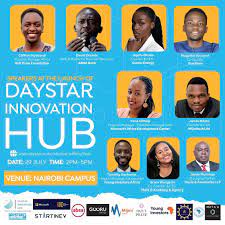
    A colorful and electric launch event beamed the corridors of Daystar University Nairobi Campus after the long-awaited launch of the Daystar Innovation Hub. Very well designed, the school’s auditorium held the extravaganza. I-HUB is here to foster innovation and creativity among the Daystar community and beyond. It’s an opportunity for young people to place ideas on the table that will make a difference, solve a problem and in the long run of it all, earn you money!

    I-HUB, an 18-member team, inclusive of DUSA President Walter, had a handful of their members appear on stage. The members shocked the audiences with mind-blowing ideas and strategies each had at the back of their heads for solving an identified problem.

    Nairobi Campus principal and professor school of business and economics, Prof. Michael Bowen preceded with a splendid lively unison performance of the National Anthem, East African Anthem, and our beautiful Daystar Anthem by attendees, approached the podium to site his welcoming remarks and a word for the I-HUB launch. He recognized the presence of Irene Githenji, the chief guest (Program Manager Education Engagements- Microsoft Africa Development Centre), David Onundu (SME and Women in Business Specialist- ABSA Bank), James Ndoto ( Founder and CEO Mijinitech Ltd), Startinev Group, Guuru Energy, Timothy Gachucha ( Head of Strategic Partnerships, Young Investors Africa) Grace Wangeci ( Co-Founder and CEO, Meta G Academy and Agency), Sisule Musungu ( Managing Partner, Sisule and Associates LLP), the DUSA president Nalwa Walter, and the I-HUB team.

    Prof. Bowen encouraged learners to understand the path to success is a rough and rocky one, failure is part of the journey, and one should expect to stumble, however, in the quest for greatness, giving up is not an option. In encouraging students, he urged them to engage in the club and stretch their mental muscles to be their leading generation of income in this new digital era. Taking in too much social media is hazardous to the brain. It makes the thinking organ unable to be a thinking space because it resides in fantasy. Bravely, he encouraged all to exercise their democratic rights in the nearing August 9th Polls and elect leaders of sober minds.

    IHUB President gave a brief remark on what Innovation entails, also expressing her satisfaction with having the speakers present, for they will have a long-term impact on the club members upon the delivery of their speech.

    DUSA President Nalwa Walter relayed his support to the birthed club, I-HUB. Mr. Nalwa encouraged students from both campuses of the distinguished liberal arts school to actively and seriously take part in school clubs formed like the I-HUB. He urged the students to find a gap and try to fill in the gap- solving a problem. Whether in school or outside school. Being the game changer.

    Dr. Munyao stood in for Dr. Caroline Ayuya I-HUB patron. He said innovation is relevant for change in the world. It is a way of life about the world’s rapid evolution. increasingly, ideas are birthed in the university, a quote from Steven Jones he mentioned carried the day “Innovation does not come just from giving people incentives it comes from creating environments where their ideas can connect”. Mobile banking, app developments- for collaboration purposes-, and the covid-19 testing among many are the notable innovations present in our country that are making a difference.

    Poster showing invited guests for the Launch of the Daystar I hub

    The keynote speaker Ms. Irene Githenji gave her remarkable life-changing remarks to the audience on innovation. She talked about how her group at Microsoft looks to foster ideas. She addressed the Microsoft garage where they ask students to jet in and create with their ideas. The idea to use the word “garage” was concerning Apple’s Steve Jobs and Microsoft’s Bill gates whose ideas were both formed while they were in a garage. She mentioned on having a growth mindset, is finding ways to deal with obstacles in life without them hindering your progress. Efforts from Africa Development to support academia and institutions are through platforms such as Hackathon- for purposes of building a technology portfolio for the students. A Framework workshop garage which helps one on how to ideate. According to Githenji, the group also looks forward to technical skilling for the untrained- giving training and certification vouchers for the learner. Microsoft also looks to get one with resources to have you started through the Microsoft startup hub -cost-free. Partnerships too, are also to grow talent and work together.

    A panel moderated by Israel Lugadiru was engaged and also gave light to the Daystar Innovation Hub on what they needed to know in the field of innovation.

  • THE 2022 PRESIDENTIAL DEBATE

    (Photo courtesy of Daily Nation)

    By Sophie K. Murithi
    (sophiekinya3@gmail.com)

    The 2022 Presidential debate was held on 26th July, 2022 at the Catholic University of Eastern Africa auditorium as from 5:00pm to 10:00pm. It was organized through a joint Media Initiative which brought together the entire Kenyan media fraternity.

    The first segment began with David Mwaure of Agano Party showing up at the podium alone. It was alleged that Mr. George Wajackoyah arrived at the scene but decided not to participate in the debate. Roots party spokesman Mr. Wilson Muirani alias Jaymo ule msee stated that the Roots party presidential candidates would not be subjected to the joke of an incoming president since the media had already predetermined a president and placed Mr. Wajackoyah in the category of ‘others’.

    The debate began with Mr. David Mwaure defending himself on why he should be elected president where he said that in spite of him being a man of the cloth, he is a lawyer by profession and a senior counsel by virtue of 39 years. He added that he is qualified to run for presidency as he is a Kenyan citizen and the constitution allows him to do so. In addition to that, he said that he was a new person and he believed that for this nation to change, it has to be led by a new and clean person with no corruption cases.

    Issues discussed during the interview included national economy, integrity, education, food, security, climate change and matters employment. The Agano party leader ensured Kenyans that his government would endeavor to create employment at all levels. He added and said he would introduce free education up to university level. “Every Kenyan must go to school. There will be money in my government, “he said. He as well urged Kenyans to elect him as he believed he was the only president who had not been in power before and believed that if was to be elected, he would lower the high cost of food prices and deal with unemployment.

    The second segment happened with Hon. Dr. William Ruto alone since his opponent Hon. Raila Odinga sent in his apologies earlier in the week that he would not be there. During the 90-minute interview, Dr. Ruto talked about the cost of living, cost of fuel, where he would lower some of the taxes imposed on fuel, the national debt, national security, governance, independence of the judiciary and integrity.

    On matters national debt, he said he believed Kenya as a nation had what it takes to pay its debts. “This will be done by putting brakes on borrowing and raising our revenue,” he said. He as well added and said his government would put brakes on unbudgeted projects as that is the biggest source of financial problems in Kenya.

    When questioned about his integrity and the reason that his opponent refused to attend the debate, the deputy president turned it around and said his opponent did not show up because he did not have a plan or an agenda for the country and could not articulate anything and did not want to answer difficult questions since he was just a mere project.

    As he concluded his interview, Hon. William Ruto expressed he would accept the outcome of the election and if any issue were to arise, he would go to court just as the constitution states. He also encouraged voters to come out and vote on August 9, 2022 as they are the ones who will make the government.

  • The 2022 Deputy Presidential Debate

    (Photo courtesy of CitizenTv)

    By Hilda Kavai

    (hildakavia191095@daystar.ac.ke)

    The presidential running mates debate was held on Tuesday the 19th of July at the Catholic University of Eastern Africa in Nairobi. It consisted of Rigathi Gachagua, Martha Karua, Justina Wamae and Ruth Mutua from UDA, Azimio, Roots and Agano parties respectively

    The first segment of the live event consisted of Justina Wamae and Ruth Mutua and it was dominated by the triple threat of unemployment, high living costs, and corruption. According to Justina Wamae, hanging the corrupt is part of their strategy to slay the graft dragon, and safeguarding the integrity of their government would be critical. She emphasized that they had already demonstrated leadership in the fight against corruption by refusing to accept campaign payments and refusing to have their campaigns sponsored, claiming that the practice produces ineffective leadership.

    “Kenyans to shun politicians who bribe them to win their votes. Campaign bribery leads to corruption as those elected seek to return their campaign funds. We are here to give alternatives. No one owns any vote,” said Ms. Wamae.

    Ruth Mutua, a rival from the Agano Party, argued that, although previous administrations had compromised the nation’s integrity, theirs would bring in a new era of openness and confidence among Kenyans. “Lack of will has impeded the fight against corruption. Integrity is paramount to us as Agano party,” said Ms. Mucheru.

    Contrary to Ms. Wamae’s position, she asserted that their administration will instead force individuals accused of graft to answer to the law. “Our governance is not to hang anybody. Hanging is not even in the constitution. We shall follow the law to deal with the corrupt. Everyone will face the law,” she said.

    Regarding the high cost of living, Ms. Wamae stated they hoped to turn around the failing economy and boost the tax base by putting more attention on local businesses and expanding the tax base. “We shall give a conducive environment for businesses. We will also reduce the cost of agricultural inputs and reduce import costs. We shall cut off the brokers who hurt farmers,” she said.

    Ms. Mucheru, for her part, stated that the high cost of living is primarily due to leaders being corrupt, and if Kenyans can elect good leaders, then their plight will be addressed. She pleaded with Kenyans to give them a chance.

    The legalization of marijuana and exporting of snake venom became a hot topic during the debate. Ms. Wamae claimed the idea was proposed for both industrial health and economic prosperity. “Let’s look at the future. Galana Kulalu project will be about cannabis and we shall pay teachers, and civil servants with the proceeds of bhang. Unemployment and high cost of living leads to depression yet marijuana is illegal,” she said.

    Ms. Mucheru urged mothers to exercise caution regarding Roots’ marijuana aspirations, claiming that legalizing it in Kenya is not feasible.

    The second segment of the event involved Gachagua and Martha who came in next and the two were involved in a clash of personalities. The former Justice Minister Karua described herself as an honest and hardworking Kenyan who does not believe in the primitive accumulation of money. Rigathi, whose Sh200 million assets were frozen by the court on suspicion of being graft proceeds, insisted he, too, was clean.

    It was a grudge match and a battle of words from the start, with both Mr. Gachagua and Ms. Karua acutely aware that their debate performances may influence the fate of their respective principals who are Kenya Kwanza presidential candidate William Ruto and his Azimio la Umoja adversary Raila Odinga.

    Both candidates had clearly prepared well, based on the proceedings. They had thoroughly researched the policy ideas in their respective party manifestos and were well-versed in their facts and data. The two had severe disagreements about how to handle a potential fallout with their bosses if their respective parties won the next month’s elections.

    Whereas Martha mentioned the prospect of personal conflicts, Rigathi downplayed the possibility of any backlash, arguing that Kenya Kwanza cannot devolve into sideshows at the expense of solving the issues that concern Kenyans.

    Rigathi Gachagua clearly stated that they will not engage in sideshows but will instead focus their efforts on serving Kenyans and recovering the country’s economy, which is now in disarray. “DP Ruto and I are strong-willed leaders who respect each other; none of us suffers from inferiority complex. We don’t have time to disagree. What has brought us together is stronger than what sideshows can come in between us,” he said.

    It was not by coincidence that both candidates tried to swing the conversation to the subjects dear for Mt Kenya voters. Gachagua’s promotion of Dr. Ruto’s distinctive Bottom-Up economic philosophy, as well as the Hustler versus Dynasty narrative, which emphasizes issues important to the underprivileged, were also highlighted. Gachagua was eager to pit Ruto against Uhuru, as part of a campaign strategy to portray Mr. Odinga as a “project” who will be a puppet of the retiring President.

    Azimio la umoja deputy presidential candidate emphasized her and Mr. Odinga’s record of reform dating back to the multi-party campaign, as opposed to the Ruto-Gachagua record of devotion to the one-party system. Another point of emphasis was Azimio’s commitment to combat corruption, which Mr. Rigathi quickly deflected with the statement that Mr. Odinga had become an apologist for the Kenyatta government, corruption, and a collapsing economy.

    The pair took on the key issues for which their principals chose them right away: Ms. Karua on fighting corruption and promoting constitutionalism, and Mr. Gachagua on promoting an economic overhaul based on the bottom-up economic approach Kenya Kwanza says will help promote small and medium businesses.

    They did, however, agree to keep the current constitutional arrangement in place, in which both the President and the Deputy President are chosen as a ticket rather than the DP being handpicked by the President.

    The Presidential debate follows next and it will be held on the 26th of July.


  • Penzi Halijaribiwi, Utanaswa Unasike.

    (Picha kwa hisani ya The Economic Times)

    Na Abdul Shaban


    Mapenzi ya siku hizi, ni ya nipe ndo nikupe,

    Tena ya tele mapozi, kadhalika na mapepe,

    Sipo jali tawa chizi, ujipake na matope,

    Penzi halijaribiwi, utanaswa unasike.


    Penzi halina mjuzi,  nina kwambia peupe,

    panga yako mamuzi, mabaya uje utupe,

    ya sikutoke machozi, yakalovya zako hope,

    Penzi halijaribiwi, utanaswa unasike.


    Mapenzi toka awali, yaliwashinda wa kale,

    Usijione mkali, utarudi na tandale,

    Samsoni nguvu kali, alinaswa palepale,

    Penzi halijaribiwi, utanaswa unasike.


    Ukijifanya bahili, kutosikia wavyele,

    Utashikika pahali, upige zako kelele,

    Kusifiwa ni muhali, huwezi kusonga mbele,

    Penzi halijaribiwi, utanaswa unasike.


    Kujipiga na kifua, eti wewe umakini,

    Utakuja kujutia, ushindwe na kibaini,

    Utalia na dunia, uhame nako nyumbani,

    Penzi halijaribiwi, utanaswa unasike.


    Mwisho nikimalizia, kwa huu wangu waraka,

    Polepole kuanzia, sikuwa nayo haraka,

    Nadhani mumesikia, madada na kina kaka,

    Penzi halijaribiwi, utanaswa unasike.