Category: News

  • DAYSTAR REUNITES WITH FORMER STAFF MEMBER KEN SHINGLEDECKER

           Courtesy visit by the former employee and his family highlights the university’s growth in infrastructure, academic programs and student population

    By Serena Kwena,

    Athi River — Daystar University recently welcomed former staff member Mr. Ken Shingledecker and his family for a courtesy visit and reunion at the institution’s Main Campus, in an event that celebrated the university’s heritage, growth and enduring relationships with those who have contributed to its development.

    Mr. Shingledecker served at Daystar University between 1981 and 1996. His return to the university offered an opportunity to reconnect with the institution’s history while witnessing its significant transformation over the years in terms of academic programmes, student population and infrastructure.

    During the visit, Mr. Shingledecker and his family toured several key facilities at the Main Campus, including the poultry farm, water treatment plant, Agape Library, the School of Nursing and the School of Law. The tour showcased some of the university’s developments and its continued efforts to expand learning resources and improve service delivery to students.

    The reunion also served as a moment of reflection on the role former staff members have played in shaping the university’s journey. By hosting the visit, Daystar underscored the importance of maintaining ties with individuals whose work and dedication contributed to the institution’s growth in its formative years.

    The university described the visit as a meaningful occasion that not only honored Mr. Shingledecker’s service, but also reaffirmed Daystar’s appreciation of its heritage and the people who have been part of its story.

    As the university continues to grow, the reunion highlighted the value of preserving institutional memory and celebrating relationships that have remained strong over the years.

     

  • Daystar University Wins KES 17.5M Grant for Kenya Child Labour Study

    By Chelangat Caren,


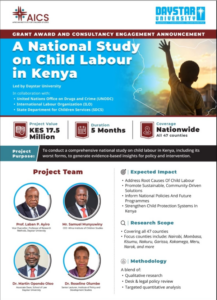
    Daystar University has secured a KES 17.5 million national grant to lead one of Kenya’s most comprehensive studies on child labour to date, placing the institution at the centre of policy conversations on children’s rights and education.

    The project, awarded in May 2026, will map the scale, drivers, and regional patterns of child labour across all 47 counties. It is being conducted in partnership with the United Nations Office on Drugs and Crime  and the International Labour Organization .

    “Research for Action”

    Daystar University Vice Chancellor Prof. Laban P. Ayiro is serving as the Principal Investigator. Speaking during recent university engagements, Prof. Ayiro has emphasized the link between culture, virtue, and human formation in tackling systemic social issues , a framework he says will also guide this study.

    “Child labour is not just a statistic. It’s about children who should be in classrooms, not in hazardous work,” a member of the research team noted. “This grant allows us to move from assumptions to evidence that can shape county and national policy.”


    Why It Matters Now

    Kenya has made strides in education access, but pockets of child labour persist, especially in informal sectors, agriculture, and urban street economies. By covering all 47 counties, the Daystar-led study aims to provide county-specific data that policymakers, NGOs, and faith-based organisations can use to target interventions.


    The research will also assess how factors like school fees, household income, and migration influence child labour trends ,findings that tie directly to Daystar’s focus on family, education, and community welfare.


    A University-Wide Commitment

    The grant adds to Daystar’s growing research profile. In June alone, the university hosted an Entrepreneurship Expo for student-led businesses, launched academic excellence awards, and strengthened international partnerships in nursing education with Taylor University.


    For students, the project opens doors to field research, data analysis, and advocacy experience. Several School of Business and Social Sciences students are expected to support data collection and dissemination in the coming months.

    Fieldwork is set to begin this trimester, with preliminary findings expected before the end of 2026. The final report will be shared with the Ministry of Labour, county governments, and UN partners to inform Kenya’s next phase of child protection strategies.


    As Prof Ayiro put it during the KESSHA Conference: building strong schools and communities requires both virtue and evidence. With this study, Daystar is contributing both.


  • Former Chief Justice David Maraga Arrested at Nairobi National Park Protest

    By Chelangat Caren,


    Nairobi, Monday June 8, 2026— Former Chief Justice David Maraga was arrested on Monday morning outside Nairobi National Park, minutes after launching a protest against proposed infrastructure construction within the park.

    Eyewitness accounts indicate Maraga was with members of his campaign team near the park’s main gate when police officers moved in to disperse the gathering. He was later placed in a police vehicle and driven away from the scene. The protest was organized to oppose plans to fence and build new structures inside the park, which conservation groups argue would block wildlife corridors critical for elephants and other animals.

    Maraga, who served as Chief Justice from 2016 to 2021, has been leading public campaigns in recent weeks to stop excisions and new developments in Nairobi National Park. The park, located 7km from Nairobi’s central business district, is the only wildlife reserve in the world with a city skyline. It previously lost over 2,000 acres to the Standard Gauge Railway project in 2017.

    Organizers described Monday’s procession as peaceful. Police intervened shortly after it began. As of 12:30pm, authorities had not released an official statement detailing the charges or legal basis for the arrest.

    The arrest occurred on the same day the High Court delivered its long-awaited ruling on petitions challenging the October 2024 impeachment of former Deputy President Rigathi Gachagua. Both events have drawn significant public and media attention in Nairobi.

    Conservationists have warned that further fencing and construction within the park could sever migration routes linking Nairobi National Park to the wider Athi-Kapiti ecosystem. Government officials have previously cited infrastructure needs and land use planning as reasons for proposed developments.

    Maraga is expected to be arraigned as police finalize statements on the arrest. The development adds pressure on Parliament and the Ministry of Tourism and Wildlife, which are already facing petitions and public submissions over the park’s boundaries. With both the Gachagua impeachment ruling and the park protest dominating headlines, the courts and security agencies face renewed scrutiny over how they balance public assembly, conservation, and state authority. This story will be updated as court documents and official statements are released.


  • Daystar University Hosts Opening of ICA 2026 Nairobi Regional Hub Conference.

    By Richard Onyango

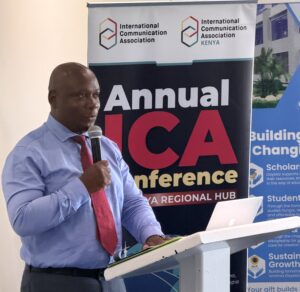
    Daystar University officially opened the 2026 Nairobi Regional Hub Conference of the International Communication Association (ICA) today, bringing together scholars, researchers, students, and communication professionals for conversations centered on communication and inequalities in society.

    The conference, running from June 4–6, is part of the 76th Annual ICA Conference taking place in Cape Town, South Africa, under the global theme, “Communication and Inequalities in Context.” The Nairobi Regional Hub is among several hubs organized worldwide to expand participation and create opportunities for scholars and students unable to attend the main conference physically.

    The opening session featured virtual addresses from international communication scholars and ICA leaders who emphasized the urgent need for inclusivity, collaboration, and mentorship in addressing global inequalities through communication. Speaking during the opening session, incoming ICA President for 2026–2027, Professor Ingrid Bachmann of Pontificia Universidad Católica de Chile, described ICA as a growing and increasingly diverse organization that still has room for broader inclusion.

    “This has become a diverse organization which still needs to grow,” she said.

    Professor Bachmann noted that inequalities around the world inspired this year’s conference theme and challenged communication scholars to intentionally create spaces that include more voices and perspectives.

    “ICA can deal with these inequalities by being aware of these inequalities and differences and being intentional about including other people and more people,” she added.

    Outgoing ICA President 2025–2026, Professor Dr. Thomas Hanitzsch of LMU Munich, commended the work being done within the African communication landscape and acknowledged the importance of regional hubs such as Nairobi in shaping global academic conversations.He also emphasized that inequality remains a major global challenge and encouraged ICA to deliberately mentor future leaders from underrepresented regions and countries.

    At the local level, Dr. Robert Aswani, Dean of the School of Communication at Daystar University and Chair of the ICA Kenya Chapter, highlighted the role the conference continues to play in advancing communication scholarship in Africa. Dr. Aswani noted that while ICA has already made tremendous progress globally, there is still room to strengthen its impact through greater interdisciplinary collaboration among scholars and researchers.

    He further described the conference as an important breakthrough platform that allows scholars, students, and practitioners to network, share research, and contribute toward addressing communication inequalities.

    The conference continues to position Daystar University as a leading center for communication scholarship in Africa. Over the years, the university has hosted several editions of the ICA Regional Hub, attracting participants from universities across Kenya and international presenters from around the world.

    This year’s conference features live sessions, research presentations, panel discussions, and breakout engagements focusing on media, digital communication, artificial intelligence, journalism, public relations, and emerging communication technologies.

    For students pursuing communication and media-related courses, the conference offers an opportunity to engage directly with scholars and professionals shaping conversations around communication in Africa and beyond.

    As discussions continue throughout the three-day event, participants are expected to explore how communication research, innovation, and collaboration can help address both global and local inequalities in an increasingly digital world.

    The conversation continues tomorrow with more panel discussions, research presentations, and collaborative engagements expected to further examine the role of communication in addressing inequalities across different contexts.


  • JERRICANS OVER SPEECHES

    By Chelangat Caren,


    The honking started at 9 a.m. on Kenyatta Avenue. Not the impatient honk of Nairobi traffic, but a slower, deliberate one. A crowd had gathered around comedian Eric Omondi as he dragged a long chain of empty yellow jerricans down the road. Each plastic container clattered against the tarmac, a sound that felt louder than any slogan.

    It was May 18, 2026, and Nairobi was back on edge over fuel prices. Two days earlier, EPRA had announced another hike. Super petrol rose by Ksh 16.65 per liter and diesel by Ksh 46.29. For most Kenyans, that was not just a number on a board. It meant matatu fares going up overnight, food getting more expensive at Gikomba, and boda-boda riders thinking twice before taking a long trip.

    Omondi’s protest was simple and theatrical. He pulled dozens of empty jerricans behind him near a petrol station, a visual jab at the reality many face: showing up at the pump with no money to fill them. “We are tired of promises. Kenyans cannot afford fuel anymore; this is crippling everything: transport, food, and business,” he told the crowd.

    Dressed in his “Sisi Kwa Sisi” hoodie with heavy chains across his shoulders, Omondi framed it as a movement for the common mwananchi. People stopped and filmed; some joined in carrying jerricans. Others just watched, nodding. By noon, police had cleared the road, but the video was already circulating on TikTok and X with thousands of shares.

    This was not Omondi’s first time turning personal frustration into public spectacle. He has protested over unemployment, taxation, and the cost of living before. But fuel cuts deeper because it touches everything else. When diesel goes up, so do school fees, vegetables, and the fare to visit your mom in Nakuru.

    Inside the studios, the tone was different. On Citizen TV’s Daybreak, Deputy Speaker of the National Assembly Gladys Shollei urged calm. She told viewers that Kenyans needed to “be patient” because the rising prices were linked to global factors like the Israel-Palestine war and the weakening of the shilling.

    She pointed to the government’s Fuel Stabilization Fund as evidence that it was trying to shield people from worse hikes. Her message was clear: the pain is real, but it was not entirely homemade, and street protests will not change the global oil market.

    Shollei has taken a hard line on protests more broadly. In Parliament she criticized former Chief Justice David Maraga for joining the June 25 demonstrations, saying they turned violent and hurt ordinary people trying to make a living. “Your rights end where the other person’s rights start,” she said.

    That is the tension playing out now. On one side are activists like Omondi, who say silence is complicity when the cost of living bites. On the other hand, leaders who argue that patience and policy are the only way through a crisis driven by forces outside Kenya’s control.

    In the middle are people like Amina, a mama mboga in Westlands, who told a reporter she now spends Ksh 200 more daily just to get her greens to the market. Or Kevin, a matatu driver in Embakasi, who says he is parking his vehicle two days a week because diesel is eating his profits.

    The government has tried cushioning the blow. In April, it cut VAT on petroleum products from 16% to 8% for 90 days after opposition leaders threatened mass action. But with global oil prices still volatile, the relief feels temporary.

    For now, Nairobi is quiet again. But the empty jerricans are a reminder that for many, “tightening your belt” does not mean much when there is nothing left to tighten. The next EPRA review will tell us if the streets stay calm or if those jerricans come back out.

  • DAYSTAR UNIVERSITY WINS KES 17.5 MILLION NATIONAL CHILD LABOUR STUDY GRANT

    By Tracy Kavai,


    Daystar University has secured a landmark national research grant and consultancy engagement worth KES 17.5 million to implement a nationwide study on child labour in Kenya.

    The announcement was made by the Directorate of Research, Innovation, Commercialization, and Entrepreneurship (DRICE), describing the achievement as a major milestone for the university’s growing reputation in impactful and policy-driven research.

    The five-month study will cover all 47 counties in Kenya and aims to generate evidence that will help inform public policy, strengthen child protection systems, and guide future interventions aimed at combating child labour and its worst forms.

    The research project will be conducted in collaboration with the United Nations Office on Drugs and Crime, the International Labour Organization, and the State Department for Children Services. The partnership highlights Daystar University’s increasing recognition as a trusted institution in national and international research engagements.

    DRICE congratulated the project team led by Prof. Laban P. Ayiro, Vice-Chancellor and Professor of Research Methods at Daystar University. Other members of the team include Dr. Martin Opondo Oloo, Dr. Roseline Olumbe, and Samuel Munyuwiny, who is also a Daystar PhD student and adjunct lecturer.

    According to DRICE, the achievement reflects the power of visionary leadership, multidisciplinary scholarship, doctoral talent, and strategic collaboration in addressing pressing national challenges affecting children in Kenya.

    The Directorate further noted that the project aligns with Daystar University’s commitment to advancing justice, influencing public policy, and transforming society through meaningful research and innovation.


    In a statement signed by Dr. Caroline Ayuya Muaka, the university community was encouraged to celebrate the milestone and congratulate the research team for bringing pride and recognition to Daystar University.


  • PETRO DOLLAR

    By Joe Aura, aurajoe6@gmail.com


    The term petrodollar refers to US dollars paid to oil-exporting countries for petroleum. This system, established in the 1970s, has been a cornerstone of US global financial dominance, by ensuring high demand for the dollar.


    How the System Works

    • The Pact: In 1974, the US and Saudi Arabia struck a deal where the Saudis would price their oil exclusively in dollars and invest their surpluses into US Treasury securities.
    • Military Protection: In exchange, the US provided military protection and advanced weaponry to the Gulf states.
    • Petrodollar Recycling: Exporters “recycle” these dollars by investing them back into US assets or buying foreign goods, which helps fund US budget deficits and keeps interest rates low.

    Impact on Global Finance

    The Petrodollar system acts as a “price amplifier” for the world. Because countries with little or no oil reserves must first buy Dollars to then buy oil. Any change in the value of the Dollar or the price of oil hits your pocket twice.

    In Kenya, fuel prices are heavily influenced by the USD/KES exchange rate. Since oil is traded in Petrodollars, Kenya’s fuel import bill (which accounts for nearly 15% of all imports) must be settled in USD. When the Shilling weakens against the Dollar, the cost of importing fuel rises even if global oil prices stay the same. As of April 29, 2026, the exchange rate is approximately KSh 129.10 per USD. This relatively high rate, combined with a 41.5% to 68.7% spike in global landed costs due to Middle East tensions, forced fuel prices to record highs this month.

    Transport fares in Kenya respond almost instantly to fuel price changes because fuel typically represents about 55% of a vehicle’s total operating costs. Following the mid-April price hike—where Diesel jumped by KSh 40.30 per liter—the Matatu Owners Association and other transporters announced immediate fare increases.

    The recent increase in these costs is primarily driven by a historic spike in fuel prices and new regulatory levies, which have created a “ripple effect” across the entire Kenyan economy. When the cost of moving people and goods rises, it immediately pushes up the price of everything else, from bus fares to the food on your plate.

    Online cab services (like Uber/Bolt) have had to strategise on how to implement a 1.5x fare multiplier to cope with these record-high costs. Ironically, even electric bus operators in Nairobi have raised fares recently, citing the broader inflationary pressure caused by the high cost of the Dollar-denominated energy market.

    For story pitches, commissioned writing, or collaborations, connect with Joe on LinkedIn:
    https://www.linkedin.com/in/aura-joe-digitalproducer/recent-activity/articles/

  • A Battle for Control?

    By Chelangat Caren,

    In a shocking turn of events, Nairobi Hospital, Kenya’s premier medical institution, has found itself at the center of a heated controversy involving President William Ruto. The dispute, which began as an internal governance issue, has escalated into a full-blown scandal, with accusations of government interference and attempts to take over the hospital.

    It all started when a group of senior doctors at Nairobi Hospital approached President Ruto, alleging mismanagement and corruption within the hospital’s administration. The doctors claimed that the hospital’s board was involved in shady dealings, including manipulation of the members’ register and embezzlement of funds .

    In response, President Ruto vowed to protect the hospital from “conmen and fraudsters,” stating that he would not allow it to be taken over by individuals seeking personal gain. The President’s intervention led to the arrest of several hospital officials, including the board chairman, Dr. Job Obwaka, on charges of conflict of interest and financial reporting violations .

    However, the hospital’s management has denied any wrongdoing, claiming that the government’s actions are an attempt to take control of the institution. Dr. Barcley Onyambu, the board chairperson, stated that the hospital is stable and operational, and that the current public friction is a result of governance issues, not institutional failure.

    The controversy has sparked outrage among Kenyans, with some accusing the government of trying to silence critics and take over private institutions. Opposition leaders, including Justin Muturi, have condemned the government’s actions, stating that they are an attempt to intimidate medical professionals .

    The implications of this drama are far-reaching. If the government succeeds in taking over Nairobi Hospital, it could set a worrying precedent for private institutions in Kenya. The move could be seen as an attempt to stifle dissent and consolidate power, undermining the country’s democratic gains.

    As the drama continues to unfold, Kenyans are left wondering what the future holds for the hospital and the country’s institutions. Will the government succeed in its bid to take control, or will the hospital’s management emerge victorious? The fate of Nairobi Hospital hangs in the balance, and the nation is watching closely.

    The Nairobi Hospital saga is a test of Kenya’s institutions and the rule of law. Will the government respect the autonomy of private institutions, or will it use its power to crush dissent? One thing is certain – the outcome will have far-reaching implications for Kenya’s future.


  • DAYSTAR UNIVERSITY HOSTS DIPLOMATIC DAY ON BLUE ECONOMY AND MARITIME SECURITY AND DIPLOMACY

    By Tracy Kavai

    ATHI RIVER, KENYA – On Wednesday, March 11, 2026, Daystar University’s Athi River campus became a global stage for maritime and diplomatic discourse as the School of Arts and Social Sciences hosted its annual Diplomatic Day.

    The high-level summit, themed Shared Perspectives on Blue Economy, Maritime Security, and Diplomacy,” brought together a formidable assembly of regional power players, international envoys, and ambassadors from the ASEAN region to bridge the gap between academic theory and the urgent geopolitical needs of the Indian Ocean rim.

    The event moderated by Dr. Radoli Ouma Radoli, PhD, Associate Dean of the School of Communication, kicked off with a vibrant performance by the Daystar University Choir and a solemn prayer session led by University Chaplain Rev. Miano Weche, who urged attendees to “take reconciliation into the world and become ambassadors of peace.”

    Dr. Radoli took a central role in welcoming a high-profile delegation that included Mr. Joseph Boinnet representing Ambassador Monica Juma, Director-General of the United Nations Office on Drugs and Crime at Vienna, Ambassador Nancy Karigithu (representing CS Hassan Joho), and Mr. Mustafa Ibrahim (representing PS Dr. Abraham Korir Sing’oei). The international diplomatic corps was strongly represented by H.E. Witjaksono Adji (Indonesia), H.E. Marie Charlotte G. Tang (Philippines), H.E. Ruzaimi Mohamad (Malaysia), Ms. Ruvini De Silva (Sri Lanka), and Ms. Piyaporn Putanapan (Thailand). Also in attendance were Lieutenant Colonel Ernest Ndirangu of the Kenya Naval Training College, Dr. Solomon Njenga of the Mashariki Research and Policy Centre, and Mr. Paul Kariuki of the ICRC.

    Opening the official speaking program, the Dean of the School of Arts and Social Sciences, Dr. Josephine Munyao, welcomed the guests by emphasizing the pedagogical mission of the day. She stated, “The goal of this annual event is to link classroom learning and real-life experiences. We are looking forward to learning a lot, and by the end of this day, we will be very rich.”

    Following the Dean, the Deputy Vice Chancellor for Academic Research and Student Affairs, Prof. Samuel Muriithi, grounded the economic discussion in ethical responsibility, noting that “God gave humanity responsibility over the earth. Let us be good stewards of creation and the ocean economy,” while calling for firm legislation to protect the environment.

    The security of the continent’s waters was then addressed by Mr. Joseph Boinnet, the former Inspector General of Police, who delivered a message on behalf of Ambassador Monica Juma. Mr. Boinnet cautioned that economic growth is impossible without safety, stating, “We need to safeguard sea lines of communication, protect offshore infrastructure, and create stability within which trade and livelihoods can flourish.” This was followed by Mr. Mustafa Ibrahim, who noted that “diplomacy today extends beyond traditional state-to-state relations and now incorporates the blue economy to prevent systemic weaknesses in governance.” Lieutenant Colonel Ernest Ndirangu then explained the military’s role, stating that the “Kenya Navy turns maritime strategy into diplomacy, securing the ocean and building partnerships.”

    Representing the policy frontier, Ambassador Nancy Karigithu delivered a powerful charge on behalf of CS Hassan Joho, declaring, “The real blue economy is not a political concept, it’s not a slogan, but a tangible, measurable, governable resource base that Kenya is only beginning to unlock.”

    The international community then provided a global blueprint for cooperation, led by H.E. Witjaksono Adji, who described the Indian Ocean as a “bridge connecting Africa and Asia.” He was supported by H.E. Marie Charlotte G. Tang, who remarked that “advancing maritime rights is a shared responsibility,” and H.E. Ruzaimi Mohamad, who highlighted Malaysia’s model of safe maritime activities. Ms. Ruvini De Silva and Ms. Piyaporn Putanapan both concluded that diplomacy remains the primary tool to ensure the Indian Ocean remains a zone of peace.

    The technical and humanitarian complexities were rounded off by expert perspectives from Dr. Solomon Njenga, who detailed the “Climate-Security-Peace nexus,” and Mr. Paul Kariuki, who reminded the summit that humanitarian protection must remain at the heart of all maritime policies.

    The event concluded with cultural networking and a tree-planting ceremony, reaffirming Daystar University’s mission to shape future global citizens through excellence and servant leadership.


  • DAYSTAR HOSTS FINANCIAL LITERACY FORUM

    By Tracy Kavai

    The Daystar University Students Association (DUSA) hosted a Financial Literacy Forum under the theme “Money, Freedom and Choices” on Wednesday, March 4, 2026, at the Main Campus Amphitheatre in Athi River. The event, which ran from 10:00 a.m. to 4:00 p.m., attracted a vibrant turnout from students across the university community.

    The forum brought together experts from the Institute of Certified Public Accountants of Kenya (ICPAK), the National Treasury of Kenya, ICEA Lion Group, and CIC Asset Management to unpack critical issues around personal finance, including budgeting, savings, and investments.

    Delivering the keynote address, CPA Stanley Mutua, CEO of Lofty‑Corban Investments, spoke on the theme “Money, Freedom and Choices.” He reminded students that money is more than currency, describing it as a tool that provides independence, stability, solvency, and peace of mind.

    “Most financial stress comes from the lack of a simple plan. Begin with savings, build an emergency fund, and then invest wisely. Debt is the fastest way to lose freedom, pay off expensive loans first, then invest consistently,” he said.

    Mutua also challenged students to adopt a 7‑Day Financial Action Plan to take immediate control of their finances. The plan encourages students to write a budget separating needs, wants, and goals; identify and eliminate at least two spending leaks; open or activate a savings or money market fund; set up automatic weekly transfers; learn one investing concept such as inflation, compounding, or risk; explore a side‑income idea based on their skills; and review their progress over 30 days.

    He further simplified investing by linking traditional asset classes to practical student realities: preservation through savings and money market funds, income through bonds and dividends, growth through equities and balanced funds, and longevity through diversified, long-term investments.

    Also contributing to the forum, Aguyah Wilfred Aguya, a Financial Advisor at the ICEA Lion Group, emphasized the importance of discipline and consistency in investing. He encouraged students to avoid debt-driven investments, diversify their portfolios, and focus on long-term compounding strategies to build wealth.

    Elizabeth Mureithi, Wealth Advisor at CIC Asset Management, urged students to recognize and develop their God-given talents and skills as a foundation for financial independence. She highlighted those personal abilities, whether academic, creative, or entrepreneurial, can be nurtured into sustainable income streams and long-term opportunities.

    DUSA Treasurer Purity Wangui reinforced the importance of financial literacy, noting that the forum aimed to equip students with practical life skills beyond the classroom.

    “We want Daystar students to leave here not only with academic knowledge but also with the ability to make smart financial choices that shape their future,” she said.

    The event offered more than just learning. Attendees enjoyed refreshments, free Red Bull cans, and transport arranged for students traveling from the Valley Road campus.

    The forum was made possible through the support of sponsors including the Daystar School of Business & Economics, ICPAK, ICEA Lion Group, CIC Asset Management, Red Bull, and Zhele V3/Shelev X3. Their partnership highlighted the importance of empowering young people with financial knowledge and practical skills.

    By the end of the forum, students left inspired to take greater control of their financial futures through informed decision-making, disciplined saving and investing, and responsible financial leadership.