Tag: daystar university

  • On The Presidential Debate

    By Samuel Owino

    The presidential debate on April 14th at Daystar University’s main campus was a sight to behold. Candidates for various positions arrived dressed to impress, accompanied by entourages that turned heads and sparked conversations. Their sharp rhetoric and commanding presence brought a unique energy to the event. Daystar’s political scene may not rival the intensity of the University of Nairobi, but it has its charm, like a high-stakes game owned by the privileged. Uhuru could only wish.

    In a spirited showdown of ideas and leadership, candidates from various top student positions—international students’ representative, speaker, school governor, secretary general, deputy president, and school president—engaged in a dynamic debate. These coveted roles represent the pinnacle of student leadership, the highest aspirations for any ambitious student, eager to make a difference or not.

    The debate had some interesting moments, but what stood out most was what wasn’t said. Contestants often give polished reasons for wanting to be elected, but their real motivation?   Power, money, and what they can do with it. This remains unspoken. It’s a reality that shapes student politics, even if no one admits it.

    It’s true! Money is the elephant in the room during these elections. Contestants stick to polished answers about leadership and service, steering clear of the financial perks tied to their positions. It’s an unspoken truth that everyone knows but no one dares to address. After all, admitting it outright would risk sounding self-serving and could undermine their credibility. It’s a delicate dance, but the silence on this topic feels like a missed opportunity for transparency.

    This unspoken reality is also evident in the promises made during the debate. For instance, Fredrick Imbukwa’s pledge to abolish mandatory payments for the SOEA event sounds appealing, but it’s unlikely to happen. SOEA has always been a paid event, and the cost will only go up. His promise, though well-meaning, feels more like wishful thinking than a realistic plan.

    Presidential candidate Lewis Sekento made his mark during the debate. Though he comes across as soft-spoken and gentlemanly, there’s a determined edge to him. His discipline is striking—almost psychotic—and he’s relentless in pursuing his goals. This drive might be all he needs to build a lasting legacy in politics.

    Sekento also delivered some memorable lines during the debate. One that stood out was his response to an audience member:

    “Having a backward mentality is not a problem. It is unfortunate.”

    The remark was sharp and timely, showcasing his wit and composure. With these qualities, he seems well-prepared for the challenges of national politics, should he choose to pursue them.

    Edgar Nyambane stood out in the debate despite not being the most popular candidate. His responses were thoughtful and showed a knack for policy-making, making a strong case for why he deserves a shot at the presidency. When asked about addressing drug addiction and mental health, he proposed forming a committee to tackle these issues. While DC3 already works in this area, a dedicated committee could bring fresh perspectives and solutions.

    He also addressed the challenges of the university funding model, promising to ensure that government-sponsored students receive scholarships if funding becomes an issue. His ideas reflect a practical approach to leadership, grounded in addressing real concerns. Nyambane might not have the loudest following, but his focus on meaningful policies speaks volumes.

    The presidential debate always has its share of forgettable moments, and Jerry Amimo, running under the DUPA ticket, was one of them. He appeared to lean heavily on the party’s popularity rather than presenting any substantial ideas. His contributions lacked depth, leaving little to remember.

    That said, leadership is more than just words. Perhaps Amimo’s strengths lie elsewhere—maybe he’s the right person for the job in ways that weren’t evident during the debate. But based on his performance, he struggled to make a convincing case, even to the most forgiving audience.

    Though I may not be an expert (in all I have said), I would encourage the newly elected Congress to prioritize wisdom and integrity over popularity. Our choices today set the foundation for a better future—the next year. With the national stage already in disarray, we must begin the change here, within our community. This is where progress takes root, and this is where it must flourish.

    An interesting observation. It seems like women often step into deputy roles, which might reflect a broader societal pattern of women being seen as strong supporters rather than primary leaders. But honestly, it’s high time that changed, and seeing more of them vying for the presidential seat would be a game-changer. Maybe it’s about breaking those invisible barriers and encouraging more of our girlies to aim for the highest office. What’s up with that?


  • Your Weekend Plans

    By Samuel Owino

    We all know how stressful weekdays can be, with never-ending assignments, continuous group work, and weekly classes. With all this, we always opt for out-of-the-house weekend plans: a dinner, a hike, or a drive. A weekend watching movies can often be overlooked, mainly because it is difficult to find a good movie—give a movie more than five minutes— or the endless subscriptions one has to pay to watch a single movie. My take, get a VPN and subscribe to HBO, Hulu, or Prime Video for American films and TV. Get Netflix for your Asian fix. Anyway, here are some films and TV shows to watch next weekend.

    Luckiest Girl Alive

    This is a Netflix film about a sharp-tongued New Yorker who appears to have it all: a coveted job at a fancy magazine, a designer wardrobe, the perfect fiancé, and a dream wedding on the horizon. When the director of a crime documentary invites her to tell her side of the shocking incident that took place when she was a teenager at the prestigious Brentley School, Ani (Mila Kunis) is forced to confront a dark truth that threatens to unravel her meticulously crafted life.

    Faceless

    After finding himself at the wrong place and at the wrong time, an escaped convict, Kaburagi, takes the authorities in Japan on a wild goose chase. Faking identities and changing locations while trying to prove his innocence by studying the law. Will the right place right time save him? This thriller will keep you on the edge of your seat.

    How to lose a guy in 10 days

     Benjamin (Mathew McConaughey) is an advertising executive who takes on a bet to make any girl, of his competitors’ choice, fall in love with him to take control of a deal. On the other hand, Andie (Kate Hudson) takes a challenge to write better stories for the magazine she works at. The title of the article she is to write is How to Lose a Guy in 10 Days. Who will lose?

    The Marvellous Mrs. Maisel

    A period comedy-drama based in the 1950s, Miriam “Midge” Maisel has a perfect life: a perfect husband, two kids, and an apartment in the Upper West Side. When her husband leaves her for his secretary, she discovers a hidden talent—stand-up comedy. This talent takes her through the city comedy industry from her comfortable life to the downtown comedy clubs and cafes. This series draws inspiration from the life of Joan Rivers, an icon and a respected name in comedy.

    The White Lotus

    Picture a resort brimming with opulence, where a cast of privileged characters gathers to indulge in their wildest impulses. What begins as a retreat filled with relaxation and luxury takes a dark turn as the guests’ hidden flaws and entangled lives disrupt the serene atmosphere. The staff, eager to maintain the illusion of paradise, finds themselves drawn into the chaos. Through sharp and cutting satire, the series exposes how extravagance and entitlement reveal deeper cracks within human nature, as the resort’s picture-perfect charm slowly crumbles under the weight of instability.

    These are just some to get started on. If you have already watched all of this list, you are definitely on the right path, and with impeccable taste, you don’t need advice. By the way, what happened to Friday movie nights by DC3?


  • Fine urban interiors partners with DUSA for creative workshop

    Luxury interior design company Fine Urban Interiors has partnered with the office of the Nairobi Campus Secretary to offer a creative workshop for students.

    The workshop aims to help students who are interested to learn more about the fields of content creation, digital marketing and real estate. Fine urban interiors are a construction company which majorly focuses on high end constructions with them specializing mostly in interior designs. The company has perfected the art of digital marketing and have managed to accumulate a huge following online. Currently their YouTube channel boasts of 91,200 subscribers with more than eight million total views.

     While announcing the partnership on Monday, Daystar University Nairobi Campus Secretary Newton Kamuyu acknowledged that the design company are the perfect partner for the workshop due to their digital marketing and content creation prowess.

    “Fine urban interiors have mastered the art of digital marketing, which has enabled them to amass a huge following online which in turn makes them a perfect partner to assist us in equipping our students with these skills which are ever more important in this modern world,” he said.

    Newton Kamuyu

    He went on to encourage students to enroll for the workshop which will be taking place this semester. “I really hope that many students will come and participate in order to learn about the content creation space. It is not everyday that you see a construction company manage to achieve the same level of digital success that fine urban has managed and I believe there is a lot to learn. During the workshop you can also learn more about the Kenyan real estate market as well as how to make luxury lifestyle content.” Apart from the workshop, the company will also be offering some slots for students to appear as casts in their real estate videos.

    Uptake in luxury lifestyle content

    In recent times there has been a serious uptake in luxury living content on Kenyan social media. The uptake has seen content creators who made different kinds of content toss their hats into the ring of luxury lifestyle content. A prime example is Seth Gor whose claim to fame was his comedic skits but in recent times has switched his focus to the lifestyle and fashion segment which seems to be very popular due to its able to attract advertisers and partners. This ability to rake in advertising money as well as collaborating with desirable brands has left many youths desiring to become content creators or as they are more commonly referred to as Influencers. It is in this niche that Fine Urban Interiors has managed to be successful as they showcase properties which they have managed to spruce up into spaces of luxury living.

    The company also tends to work with influencers and celebrities who are known for luxury lifestyle such as Ugandan celebrity Zari Hassan and Sheila Mwanyiga among others.

    The real estate content segment has also had a huge bump in popularity In the Kenyan space in recent times as Kenyans now desire to see homes that are in their neck of the woods as opposed to those far away in Beverly Hills.

  • Thieves posing as Daystar students steal two bikes from businessman

    by Sumaya Hussein

    (husseinsumaya1@gmail.com)

    Student entrepreneur Noah Karuri at his bike station few meters from Daystar University, Athi River – PHOTO/Denis Mavia

    Two men stole two mountain bikes from a student with a bike hiring business using a lost student ID that belonged to another Daystar student. The two men hired bikes from Noah Karuri, the business owner, on May 25, never to be seen again.

    According to Karuri, the men looked like students and one of them resembled the picture in the student ID, which was handed over before taking the bikes as per the regulations. The two also left their mobile numbers, one a Safaricom and the other an Airtel number, before taking off at around 3pm.

    “They were new clients. I had not seen them around, so I thought they were freshmen. When they came to hire the bikes, they asked me about the requirements and I told them they had to leave their IDs, either national or student ID, and their phone numbers too,” said Karuri

    According to Karuri, the two men did not specify where they were going and how long they would take. Since they said they were headed to Mombasa Road, Karuri decided to call and check in on them after two hours. He dialed the Airtel number for the first time at around 5pm and the owner picked, saying the two were on their way back.

    “After one hour again, I called them at around six. They said they’re almost at Lukenya Getaway. But at that point I felt suspicious,” said Karuri.

    In a state of panic, Karuri took a bike to Lukenya Getaway to try and locate the men but did not see them. He went further up to Lukenya Boys High School and the result was the same. He called again at around 6:30pm, but this time, the number did not go through.

    “It was off. I couldn’t believe it,” said Karuri. “I chose to think that maybe their phone went off or something came up and they’re still coming,”

    After closing the business for the day, Karuri in the company of a friend, cycled to Mombasa Road in search of the bikes.
    “We cycled all the way to Green Park then to Devki, and we came back at around eight. We didn’t see anyone,” said Karuri.

    Going back to his records, Karuri was shocked yet again when he discovered that the other number left behind was incomplete. It had one less digit and this led him to think that the disappearance was planned.
    “It was strategic. So I was sure that something had really happened,” said Karuri.

    The following day, Karuri reported to the matter to the police, who asked him to first confirm with the university whether the student ID left behind was still valid.

    After following up on the matter, Karuri learnt that the ID belonged to a student, who misplaced it in early 2020 and replaced it two weeks later. Speaking to Involvement, the third-year Valley Road student said that he lost the ID when his wallet was stolen in Nairobi West. The student who goes by the name Trevor alone, also mentioned that he has never been to the Athi River Campus.

    After checking back with the police, Karuri learnt that the new information further complicated the mystery. He was told that there was not much that could be done since the ID used was fake and the Airtel number would be hard to trace.

    Being the first time it has happened, Karuri said that the loss affected him to a point that he couldn’t sleep or eat. He now lives in constant fear that his business might be targeted again.

    “I have had trauma every day,” said Karuri. “A lot of trauma. When someone leaves with a bike, I can’t help but wonder whether or not they will come back especially if it’s a new person”.

    The incident however, he says, has made him more vigilant and forced him to introduce stricter protocols in his business.

  • Win for Media Students as Daystar Studios receive high-tech equipment

    By Sumaya Hussein

    (husseinsumaya1@gmail.com)

    Complete studio at the Valley Road Campus. PHOTO/Eric Kadenge

    This week saw studios at the Valley Road campus and Shine FM get filled with high-tech equipment, donated by the University of Northwestern- St Paul. The donations worth Ksh10million arrived at the Nairobi campus on Wednesday, and on Friday for Shine FM in Athi River.

    Dean, School of Communication Prof. Levi Obonyo was present during the installation of the equipment at the Shine FM studios. Speaking to Involvement, the Dean said that the upgrade is a win for communication students since they will have a chance to interact with equipment that is “on a different level”.

    “The only problem with this equipment now is that you might get stuck when you go out to the industry,” said Prof. Obonyo, adding that such gear is rare to find.

    The Nairobi campus has five complete studios equipped with microphones, monitors, speakers and a digital console. Shine FM studios have been upgraded and fitted with high quality radio technology for better broadcasting.

    The equipment was brought to the campuses by a team from Northwestern University, who set up the studios and trained staff on how to operate the gear. Director of Engineering Rod Thannum said that the donations were a good way of honoring the Lord and making the studios modern.

    “Hopefully the students can get a great experience and when they go out to the market place, they’ll be trained on high-tech gear,” said Thannum.

    University of Northwestern-St Paul is a private Christian university in Roseville, Minnesota. The institution owns a number of radio stations in the mid-west and Eastern United States, broadcasting listener-supported Christian music and teachings. Each year the university raises funds for mission projects such as the one in Daystar. “It’s the way that the listeners of Northwestern can bless other people throughout the world,” said Thannum.

    According to Thannum, Daystar was listed as a beneficiary some years earlier but the COVID-19 pandemic delayed the arrival of equipment. “After about a year and a half of cancelling flights, we are finally here,” said Thannum.

    Media students are particularly excited about the new equipment whose arrival followed the completion of the new studios at the Valley Road Campus.

    Studio technicians receive brief training on how to operate the new equipment. PHOTO/ Eric Kadenge

  • INVOLVEMENT ISSUE 239


    Use the link above to access the Involvement Newspaper issue 239 which features a range of articles written by our writers to ensure that you stay informed on News within and outside Daystar.

  • Culture Corner: Polygyny among the Maasai of Kenya

    By Hilmelda Tenkeu

    (hilmeldatenkeu@gmail.com)

    Thumbnail Photo Courtesy of theconversation.com

    It is not inconceivable that the average Maasai man marries three women or even more. That is in fact what is expected of him, as long as he has the financial capacity and ability to cater to them and the offspring of that union. The Maasai are the most well-known and recognized indigenous ethnic group in East Africa.

    Group of Maasai Men . Photo Courtesy of exploring-africa.com

    They live in southern Kenya and northern Tanzania along the Great Rift Valley. Their population in Kenya is expected to be about one million and counting. Despite civilization and western cultural influences, the Maasai are widely known for clinging to their traditional way of life. It’s common to see them in their traditional dress, even in the streets of the cities.

    The culture of the Maasai is mainly based on their cattle. From them, they obtain everything they need: meat, milk, and blood. Another aspect of culture among the Maasai is polygyny. They account for the majority of polygynous marriages in Kenya but from the look of things, the culture might evolve and change

    The Maasai culture is predominantly patriarchal, and that is why a girl’s childhood is dominated by a strict avoidance, and fear, of her father and other men. Her marriage prospects and her family’s reputation hinge on her ability to develop an acute sense of respect. She is socialized to accept her subservience to her future husband.

    This is one of the reasons for which polygyny is still practiced among the Maasai. The girl is taught to respect the man and even fear him.

    Back in the day, women did not have a say in the choice of their husbands but as time goes, culture evolves. Now, a woman can choose whom she wants to marry, bearing in mind that she will be joined by another woman as the marriage journey goes on.

    These women have grown up in polygynous homes and, that is what they know to be the best form of marriage. It is not essentially a practice to be abhorred, so far, there have not been major complaints.

    The practice is organized and respects certain norms that have been established and followed through to date. When a young Maasai man is ripe for marriage (usually around 25 years old), he marries the lady he has been wooing (if both families have no objection). This young girl is habitually around 15 years of age and knows the fellow. Before the young man marries, he makes sure he is financially secured to look after this family that he is about to start.

    This aligns with the general thought in the African society that a man is responsible for his family. He is the sole provider for his family and has to make sure nobody lacks. The upbringing of the boy child in the Maasai community ensures this is followed .

    Whereas the girl is always with her mother and other ladies, learning how to cook, look good, take care of herself and her future household, the boy child is with his father, the other men, or herding cattle. He has to learn to be a man, handle disputes amongst many wives and always provide for his family no matter how large it gets.

    The boy child grows up taking care of cattle and other livestock. By the time he has been circumcised and is learning the ways of marriage, his father gives him his own cattle and he begins to take care of these and multiply, such that his own family never lacks.

    This is one of the reasons for which polygyny is considered good by many cultures in Africa and the world at large. Yaayai, the first wife of a Maasai polygynous marriage has been interviewed by a popular and certified youtuber on the topic of polygyny.

    To the question why do the Maasai practice polygyny, she says “the Maasai have many wives because it is good… many wives bear many daughters from whose bride prices the family gets cows and this adds the family wealth.”. “I liked it a lot when the second wife came in, I was very happy. Even when the third was brought in… we live happily together… no we are not jealous of each other, we live together, cook together, take care of the children together”, she adds.

    A Maasai Man and his wives. Photo courtesy of bbc.com

    Whereas Yaayai welcomed her co-wives, Josephine another first wife to a Maasai man says she looked for her two co-wives. After about ten years with her husband, she found him a second wife “to help her take over “, she says. Then, a third who was strong enough “to take care of their husband, since the two of us are already tired with children”., she adds. Here, the first wife found the others and we understand that she wanted help in the chores, taking care of the children, and satisfying her husband. Her husband has to be satisfied: no matter what that entails.

    Yaayai explains this further when she says “I like my husband to have other wives so that we can be together. For example, in the afternoon like now, sitting outside together with my co-wives. We talk, we spend time together, even without our husband… whatever you were raised with, that’s what becomes your truth. That is why we don’t want our husbands, only to have one wife.”

    Talking about the next generation and polygyny among the Maasai is quite sad for Yaayai. “Young people don’t want to follow this tradition anymore; I can see that they will stop doing it because it shows that they don’t want to be in polygynous marriages anymore.

    The world is changing… people have come to know many things and many Maasais want to dilute our culture”, she laments. There is no single definition of a happy marriage. Yaayai, Josephine together with their co-wives say they are happy in their marriages and prefer polygyny to Monogamy.

    Another person from a different culture will never understand why she would share her husband with another woman. In other cultures, two men can marry and two women too.

    It is the diversity of cultures that makes the world a beautiful place to live in and like Yaayai says, “whatever you were raised with, that is what becomes your truth”. Let our different truths, not disqualify another’s.

  • Daystar Launches Sexual Harassment Policy

    By: Sumaya Hussein (husseinsumaya1@gmail.com)

    Thumbnail photo courtesy of Daystar University

    Daystar University launched a sexual harassment policy that applies to all members of the institution during the February 11 chapel service at the Nairobi campus.

    Spearheaded by the Human Resource Department, the purpose of the policy, is to create a safe working and learning environment in the institution and allow ease of reporting mechanisms.
    “We want to ensure the environment where the students are studying is safe and secure, and so we came up with that policy”, said Human Resource Manager, Pius Muia.

    DVC-ARSA Prof. Faith Nguru and Human Resource Manager Pius Muia present the Sexual Harassment Policy to Head of Youth and Mainstreaming, Ministry of Education Mr Stephen Jalenga. Photo courtesy of Daystar University.

    The policy contains procedures of how students and staff can make complaints, guidelines for carrying out follow up investigations as well as information on how to handle emergency situations. According to Legal Manager, Mueni Nyobaki, the policy will also serve to create awareness around sexual harassment and promote a culture of good conduct. “The policy promotes training and education at all levels, so when we invite you for sexual harassment policy training, don’t be shy, please come”, said Nyokabi.

    Legal Manager, Mueni Nyokabi during her presentation on the Sexual Harassment Policy. Photo courtesy of Daystar University.

    In attendance was Deputy Vice-Chancellor Academics, Research and Student Affairs, Prof. Faith Nguru, Head of Youth and Gender Mainstreaming Ministry of Education, Mr Stephen Jalenga, members of the faculty, students and staff. “Anyone can be affected by sexual harassment. More ladies are affected than men, therefore, we need concerted efforts to combat the vice…” said Mr Jalenga.

    DVC-ARSA Prof. Nguru mentioned that sexual harassment cases are common and Daystar itself has had such cases brought to the University’s disciplinary committee. “Not even too long ago, we had an issue last week of this nature, so this is not something that is far removed from Daystar and even the other universities”, said Prof. Nguru.

    The sexual harassment policy has been in Daystar since 2013, however, in 2017 during the student’s unrest, matters of sexual harassment came up and therefore there was a need to revise the policy.

  • Former Daystar DVC Appointed as St. Paul’s VC

    By: Sumaya Hussein (husseinsumaya1@gmail.com)

    Thumbnail photo: New St Paul’s VC James Kombo. Photo courtesy of St Paul’s University

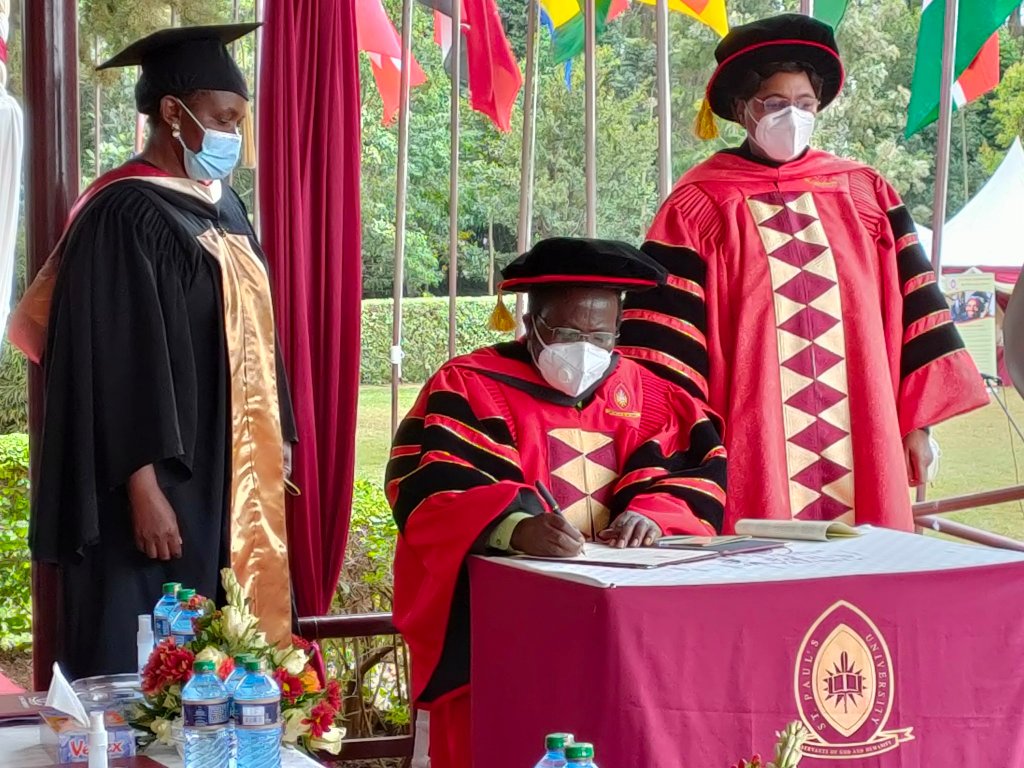
    Daystar’s former Deputy Vice-Chancellor, Prof. James Kombo, was today installed as the third Vice-Chancellor of St. Paul’s University (SPU).

    In a ceremony held today at St. Paul’s University in Limuru, the process of installation was performed by the University Chancellor, Prof Margaret Kobia, who is also the CS for Public Service, Youth and Gender Affairs.

    “I, James Kombo, do accept the position of Vice-Chancellor in this University, in the name of the Father, the Son and the Holy Spirit, amen”, declared Prof. Kombo, after which he began to be robed in the St. Paul’s gown.

    VC Prof. James Kombo signing his acceptance statement. Photo courtesy of St Paul’s University.

    The event was attended by the Senate Majority Leader, Hon. Samuel Poghisio, former St. Paul’s VC Prof. Joseph Galgallo, Daystar VC Prof. Laban Ayiro, Daystar DVC Finance, Administration and Planning, Dr Muturi Wachira and Vice-Chancellors from other various universities.

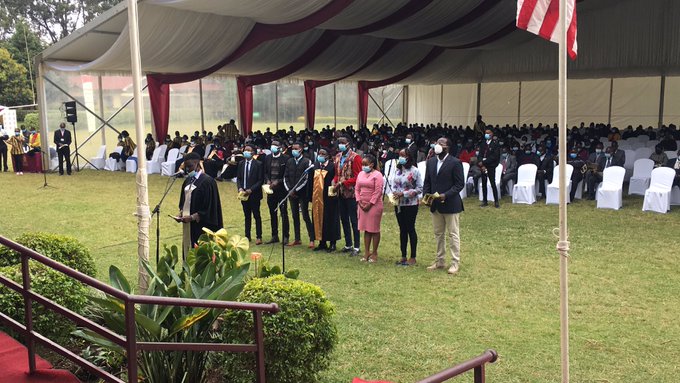
    Students receiving the new VC through their leaders. Photo courtesy of St Paul’s University.

    The former St. Paul’s VC handed over the University seal, charter, mace, logo and flag to Chancellor Kobia, who then gave them to Prof. Kombo. The installation was finalized when Prof. Kombo signed his acceptance statement, witnessed by the Chancellor.

    Former St Paul’s VC Joseph Galgallo. Photo courtesy of St Paul’s University.

    The Chief Guest Hon. Samuel Poghisio during his speech acknowledged Prof. Kombo saying that his installation “marks yet another milestone in the long journey of SPU to transform itself into a centre of excellence within the context of Kenya and Africa’s realities and needs”.

    Hon. Samuel Poghisio, EGH, MP – Leader of the Majority in the Senate. Photo courtesy of St Paul’s University.
  • Daystar Selected as ICGLR Research Institute of Reference

    By: Sumaya Hussein (husseinsumaya1@gmail.com)

    Thumbnail photo: CAS of ICT, Youth and Innovation Hon. Nadia Abdalla. Photo courtesy of Daystar University.

    Daystar University has been selected as the research institute of reference for the International Conference for the Great Lake Region (ICGLR).

    The office of the Vice-Chancellor and the Directorate of Research and Post-Graduate Studies will spearhead the initiative alongside the entire Daystar Fraternity. Owing to this, a multifunctional youth forum was held on Wednesday at the Nairobi Campus to deliberate on jumpstarting the process of developing the Regional Action Plan on United Nations Security Council Resolution. (UNSCR 2250).

    The Forum
    The forum was attended by the Speaker of the Senate, Hon. Ken Lusaka, CAS for ICT, Innovation and Youth Affairs Hon. Nadia Abdalla, and the VC Prof. Laban Ayiro. Also present were Ambassadors and High commissioners as well as representatives from the Ministry of Foreign Affairs, United Nations (UN), youth-serving organizations, International Organizations, ICGLR Fora and Daystar fraternity.

    “We are honoured as Daystar that you chose to convene this very important youth forum in this University that has a serious intention in the area of research and is a university that is heavily built on values,” said Prof. Laban Ayiro. “Not just religious values, but the societal norms that this country is so much desiring for”.

    The UNSCR 2250 focuses on ways to give youth a greater voice in decision-making at the local, national, regional and international levels. The resolution defines youth as persons aged 18 to 29 and urges the Member States to set up mechanisms that will enable them to participate in peace processes and dispute resolution.

    “Despite the fact that the youth account for more than 70 per cent of the population, they are not involved in social, economic and political spheres,” said Speaker of the Senate, Hon. Ken Lusaka, during his speech at the forum. “If the youth are not engaged in the designing, planning and implementation of programs and policies that affect not only them but also the country at large, their knowledge skills and energy become underutilized”.

    Speaker of the Senate, Republic of Kenya, Hon. Ken Lusaka. Photo courtesy of Daystar University.

    The VC Prof. Laban Ayiro insisted that the destiny of the country is in the youth, hence the need to strengthen them. “We must increase young peoples’ economic framework. Strengthening youth service system is very important,” stated Prof. Ayiro

    ICGLR is an inter-governmental organization of the countries in the African Great Lakes Region, whose purpose is to promote sustainable peace and development in African countries. It has 12 core member states including Kenya, Uganda, Tanzania, Sudan, South Sudan, Zambia, Angola, Burundi, Rwanda, Democratic Republic of Congo, Central Africa Republic and the Republic of Congo.